
Rubies have long symbolized beauty, power and romance, but a fascinating new exhibition at Harvard University proves these celebrated gemstones have equally compelling scientific stories to tell.
Now on display in the Earth & Planetary Sciences Gallery at the Harvard Museum of Natural History, "Rubies" offers a compelling side-by-side look at more than 20 pieces of fine jewelry, cut gemstones and natural ruby crystals sourced from more than a dozen countries. By pairing polished jewels with the rough crystals from which they originated, the exhibition reveals both the breathtaking beauty of rubies and the remarkable geological journey each stone has taken over millions of years.
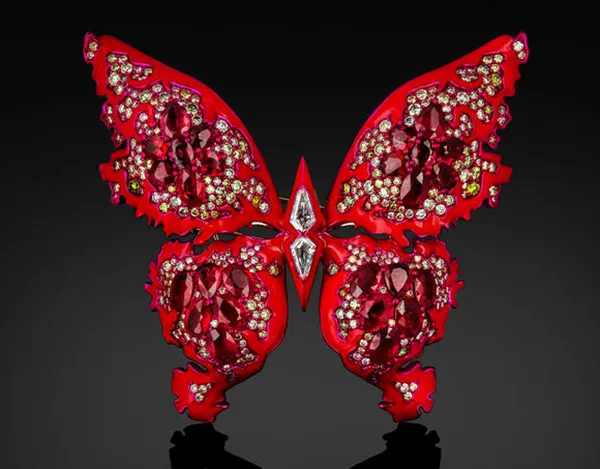
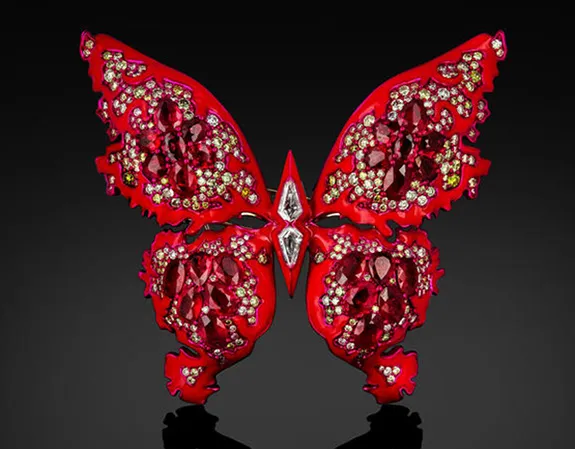
The exhibition's undeniable showstopper is "The Soul of Flame II," an intricate butterfly brooch by designer Austy Lee from the Ikhor Collection. Crafted in 18-karat rose gold with rich red enamel, the piece features unheated Mozambican rubies accented by white and fancy-color diamonds.
While the jewelry dazzles, the science behind the gemstones is equally captivating.
Visitors learn that ruby is the red variety of the mineral corundum and owes its vivid crimson hue to trace amounts of chromium within its crystal structure. That same element also gives many rubies their remarkable ability to fluoresce bright red under ultraviolet light. The exhibition also highlights the gemstone's "inner landscape" — growth zoning, mineral inclusions and delicate rutile "silk" needles — that serves as a geological fingerprint revealing where and how each ruby formed.
The exhibit also explains why Burmese rubies from Myanmar's famed Mogok Valley have earned legendary status among collectors. According to the Harvard Gazette, the Himalayan geological environment allows chromium concentrations to flourish while maintaining exceptionally low iron content, producing the intensely saturated, glowing red color that has made Burmese rubies the benchmark for centuries.
As curator Raquel Alonso-Perez told the Harvard Gazette, "Color is just one piece of the puzzle" when scientists study a ruby's origin. She added that a mineral's chemistry acts "like a fingerprint or DNA," revealing the geological conditions under which it formed.
The exhibition draws upon Harvard's Mineralogical and Geological Museum, whose collection includes more than 300,000 mineral specimens, making it one of the world's premier scientific resources. The featured rubies come from locations including Myanmar (formerly Burma), Mozambique, Afghanistan, Vietnam, Tanzania, Pakistan and North Carolina, illustrating how geography influences both beauty and composition.
The "Rubies" exhibition is scheduled to remain on display through at least the end of 2026.
Credit: Image of The Soul of Flame II brooch, The Ikhor Collection, courtesy of Harvard’s Museum of Natural History, Earth & Planetary Sciences Gallery.