
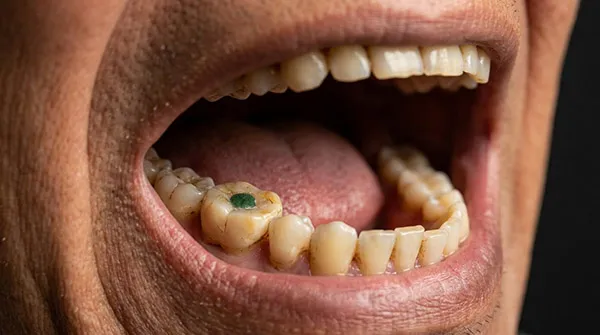
For years, archaeologists have documented how the Maya civilization adorned their front teeth with gemstones purely for beauty, status or ritual. However, a newly analyzed 2,000-year-old molar featuring a green gemstone suggests those dazzling dental modifications may have served a practical purpose, as well.
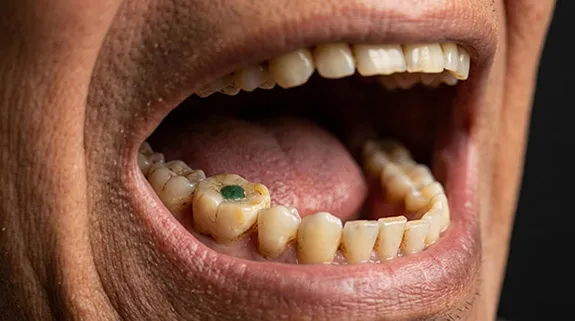
The tooth, believed to have belonged to a young adult, contains a carefully placed inlay of jadeite — a vivid green gemstone highly prized in Maya culture. Unlike earlier examples, which focused on visible incisors and canines, this stone was embedded in a rear molar, hidden from view. That crucial detail has led researchers to rethink the intent behind the procedure.
If no one could see it, why place a gemstone there?
The answer may lie in early dentistry. Researchers now believe the jadeite inlay could have functioned as a type of filling — possibly used to treat decay or protect a damaged tooth. The gemstone was precisely inserted into a carved cavity and polished flush with the chewing surface, ensuring it didn’t interfere with normal use. It’s a remarkable blend of function and artistry.
This finding builds on what we already know about Maya dental practices. In previous discoveries, artisans routinely drilled small holes into the front teeth to inlay decorative stones such as jadeite, turquoise, hematite, quartz and serpentine. These sparkling enhancements were symbols of identity and beauty — a kind of ancient “tooth jewelry” that reflected both personal style and cultural beliefs.
Equally impressive is the material used to secure these gems. Maya dentists relied on natural, plant-based resins — often derived from pine — to cement the stones in place. Modern analysis has revealed that these organic adhesives contained antibacterial and anti-inflammatory compounds, helping to protect against infection and tooth decay. In essence, the Maya may have been practicing a form of preventive dentistry.
The level of skill required to perform these procedures is nothing short of extraordinary. Using stone tools, possibly combined with abrasive powders and primitive drills, Maya practitioners carved precise cavities into enamel and dentine — often without penetrating the sensitive pulp chamber. Studies suggest that fewer than 4% of these procedures resulted in nerve exposure, highlighting an advanced understanding of dental anatomy.
The newly discovered molar takes that expertise a step further. Its irregular cavity suggests that the dentist may have removed decayed material before inserting the jadeite, effectively restoring the tooth. Combined with the antimicrobial cement, the treatment could have eased pain, slowed further decay and preserved the tooth’s function.
For jewelry lovers, the story is especially compelling. It reveals a culture where gemstones were not only treasured for their beauty, but also valued for their potential healing properties — merging adornment with well-being in a way that feels surprisingly modern.
The findings are published in the June 2026 edition of Journal of Archaeological Science: Reports.
Credit: Conceptual image by The Jeweler Blog using aichatapp.ai and a reference image of the gem-embedded tooth by E. Mata-Castillo et al. 2026.