
A Century of Luxury & Legacy
A Legacy Is a Fragile Thing: What the Biltmore Reminded Me
Published: Aug 23, 2026
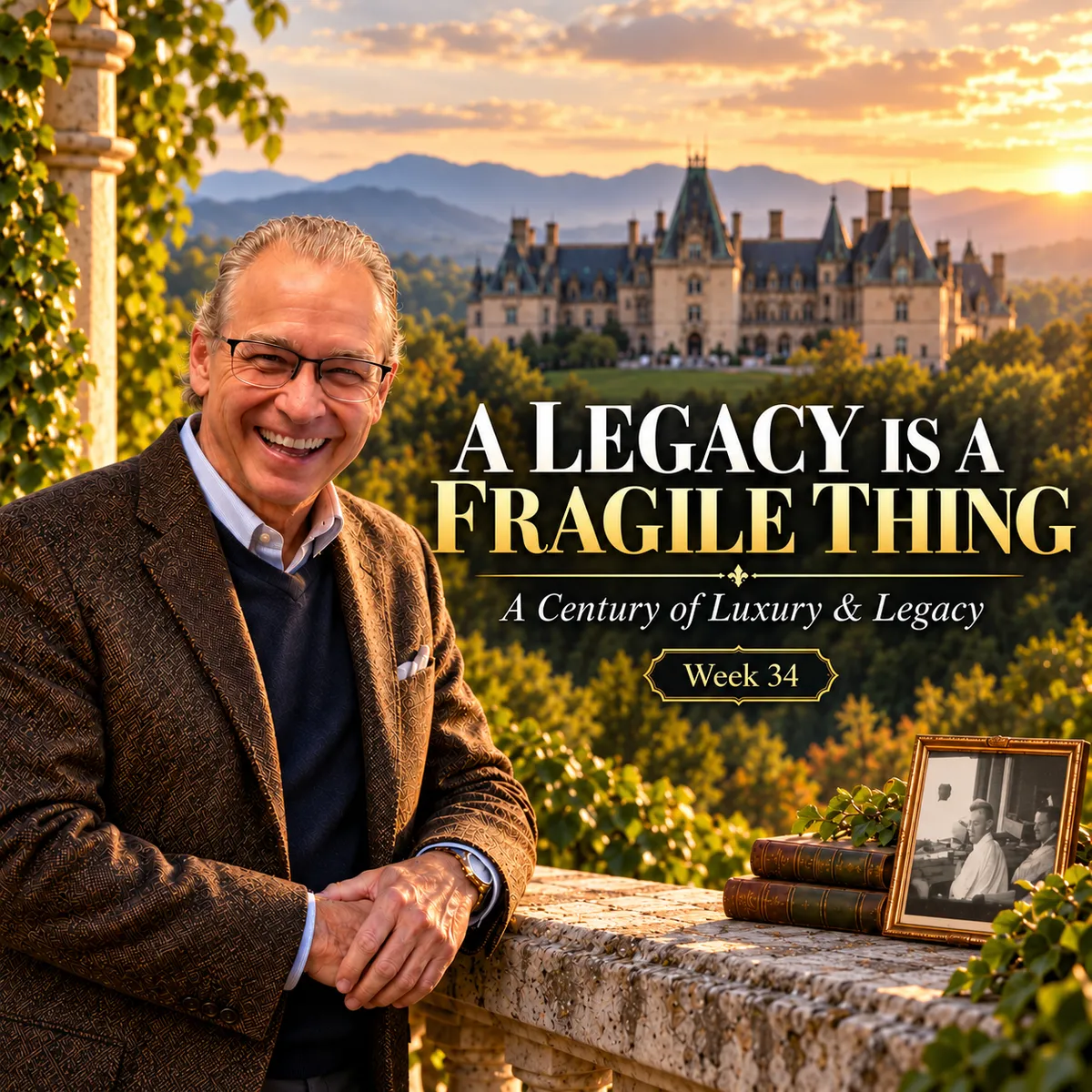
A Legacy Is a Fragile Thing
There are certain places that make you slow down and think a little differently.
For me, one of those places is the Biltmore Estate in Asheville, North Carolina.
Mary and I have been coming here for years. I think our first visit was probably close to 20 years ago. Every time we come back, it feels a little different. There is always something new to see, another trail to ride, another part of the property to explore.
These days, we like to bring our electric bikes and ride around the estate. It is peaceful. Beautiful. And honestly, it gives me time to think.
This time, as I looked up at that incredible house sitting on the hill, I found myself thinking about legacy.
And one thought kept coming back to me:
Legacies are fragile things.
Building Something Is Only the Beginning
The Biltmore Estate is an amazing example of what one family can build.
George Vanderbilt began creating Biltmore in the late 1800s, building not just a home, but an entire estate. Today, generations later, the property is still owned and operated by his descendants.
But it was not always guaranteed that it would survive.
After George Vanderbilt died, the family had to figure out how to maintain this enormous property. Land was sold. The country went through difficult economic times. During the Great Depression, the estate was eventually opened to the public as a way to generate income and help sustain it.
That decision helped transform Biltmore from simply a family home into something that could continue for generations.
Today, millions of people are able to enjoy what the Vanderbilt family preserved.
But it took adaptation.
It took change.
It took each generation figuring out what needed to happen next.
And that is what made me think about my own family.
Our Family Legacy Began in 1926
My grandfather entered the jewelry industry in 1926.
At the time, I am sure he had no idea that nearly 100 years later I would be sitting at the Biltmore Estate talking about a fourth generation of our family working in jewelry.
That is one of the fascinating things about legacy.
You rarely know you are creating one while you are doing it.
My grandfather was simply working.
Providing.
Learning a trade.
Building a life for his family.
And somehow, one decision led to another, one generation followed another, and here we are a century later.
Nobody Followed a Perfect Path
When I look back over our family history, one thing becomes pretty obvious.
There was never a grand master plan.
My dad and my uncle both stepped away from working with their father for periods of time. They tried other things, explored schooling, and eventually came back into the jewelry business.
My brothers all took different paths too.
My brother Danny was probably the one who jumped into the jewelry business most directly. He had a young family and needed to provide for them, so in many ways necessity pushed him into the trade.
He opened a small shop called the Village Goldsmith in Farmington, Michigan.
It was not some huge jewelry store. It was a small place where he did repairs, custom work, and had a showcase with a few unique pieces.
But Danny was an incredible jeweler.
Eventually, he moved on and worked for another jeweler for much of his career, while still doing what we always called “side work” from his bench at home.
That was pretty common in our family.
There always seemed to be a jeweler’s bench somewhere.
Different Careers, Same Foundation
My brother Donnie used jewelry work to help get himself through college.
He eventually became a writer and worked for newspapers, journals, trade publications, and organizations like the CDC.
My brother Dave took another direction.
He went into the military, received medical training, and eventually became the person in our family everyone called when we had a health question.
Later, he also became a pastor for a season.
For a while, Dave and I even worked together in the jewelry business while he was serving bi-vocationally.
When I look back at all of us, it is interesting.
None of us really grew up saying, “I cannot wait to spend my entire life in the jewelry business.”
Life pulled us in different directions.
We explored.
We changed.
We tried different things.
And yet somehow, the jewelry business kept weaving its way through the family.
Legacy Rarely Travels in a Straight Line
I think sometimes we imagine legacy as a straight line.
One generation builds something.
The next generation takes over.
Then the next.
And everything just continues.
But real life is rarely that clean.
People have different interests.
They move away.
They pursue other careers.
Businesses change.
Economies change.
Families change.
Sometimes people leave.
Sometimes they come back.
Sometimes someone carries the legacy because they are passionate about it.
Sometimes they carry it because they simply need to provide for their family.
And sometimes a legacy survives almost unexpectedly.
That is one of the things the Biltmore reminds me of.
The Vanderbilt family had to adapt.
They had to make difficult decisions.
They had to find ways to make what they inherited sustainable.
In some small way, every family business faces the same challenge.
The Fourth Generation
Today, I feel incredibly grateful that our family’s jewelry story is continuing.
My son Joseph represents the fourth generation.
My brother’s daughter and son-in-law are also part of that fourth generation.
That means something to me.
Not because I think every generation has to follow exactly the same path.
They should not.
Every generation needs to make the legacy their own.
But there is something special about seeing something my grandfather began in 1926 still alive 100 years later.
It is humbling.
I certainly cannot take credit for all of it.
None of us can.
We are simply one link in a much longer chain.
What Will We Leave Behind?
Whenever I visit a place like the Biltmore, I find myself thinking about this question:
What are we leaving behind?
Not just financially.
Not just buildings.
Not just businesses.
What values are we leaving?
What stories?
What lessons?
What traditions?
What example?
In our family, jewelry happens to be part of that story.
But the deeper legacy is probably about work.
Craftsmanship.
Providing for family.
Learning.
Adapting.
Showing up.
And hopefully treating people well along the way.
Those things matter far more than any piece of jewelry we could ever make.
Grateful for the Journey
As Mary and I rode our bikes around the Biltmore grounds, I kept looking at that house in the distance and thinking about all the generations it took to keep that place going.
And then I thought about my grandfather.
My dad.
My uncles.
My brothers.
My own journey.
And now the next generation.
A hundred years.
Four generations.
A family of jewelers.
I do not know exactly what the next 100 years will look like.
None of us do.
But I am thankful for what has already been built.
I am thankful for everyone who carried it before me.
And I am thankful that another generation is willing to pick it up and carry it a little farther.
Because legacy does not continue on its own.
Someone has to value it.
Someone has to protect it.
Someone has to adapt it.
And eventually, someone has to be willing to pass it on.
That may be the greatest responsibility and the greatest gift of legacy.
Doug Meadows
A Century of Luxury & Legacy
There are certain places that make you slow down and think a little differently.
For me, one of those places is the Biltmore Estate in Asheville, North Carolina.
Mary and I have been coming here for years. I think our first visit was probably close to 20 years ago. Every time we come back, it feels a little different. There is always something new to see, another trail to ride, another part of the property to explore.
These days, we like to bring our electric bikes and ride around the estate. It is peaceful. Beautiful. And honestly, it gives me time to think.
This time, as I looked up at that incredible house sitting on the hill, I found myself thinking about legacy.
And one thought kept coming back to me:
Legacies are fragile things.
Building Something Is Only the Beginning
The Biltmore Estate is an amazing example of what one family can build.
George Vanderbilt began creating Biltmore in the late 1800s, building not just a home, but an entire estate. Today, generations later, the property is still owned and operated by his descendants.
But it was not always guaranteed that it would survive.
After George Vanderbilt died, the family had to figure out how to maintain this enormous property. Land was sold. The country went through difficult economic times. During the Great Depression, the estate was eventually opened to the public as a way to generate income and help sustain it.
That decision helped transform Biltmore from simply a family home into something that could continue for generations.
Today, millions of people are able to enjoy what the Vanderbilt family preserved.
But it took adaptation.
It took change.
It took each generation figuring out what needed to happen next.
And that is what made me think about my own family.
Our Family Legacy Began in 1926
My grandfather entered the jewelry industry in 1926.
At the time, I am sure he had no idea that nearly 100 years later I would be sitting at the Biltmore Estate talking about a fourth generation of our family working in jewelry.
That is one of the fascinating things about legacy.
You rarely know you are creating one while you are doing it.
My grandfather was simply working.
Providing.
Learning a trade.
Building a life for his family.
And somehow, one decision led to another, one generation followed another, and here we are a century later.
Nobody Followed a Perfect Path
When I look back over our family history, one thing becomes pretty obvious.
There was never a grand master plan.
My dad and my uncle both stepped away from working with their father for periods of time. They tried other things, explored schooling, and eventually came back into the jewelry business.
My brothers all took different paths too.
My brother Danny was probably the one who jumped into the jewelry business most directly. He had a young family and needed to provide for them, so in many ways necessity pushed him into the trade.
He opened a small shop called the Village Goldsmith in Farmington, Michigan.
It was not some huge jewelry store. It was a small place where he did repairs, custom work, and had a showcase with a few unique pieces.
But Danny was an incredible jeweler.
Eventually, he moved on and worked for another jeweler for much of his career, while still doing what we always called “side work” from his bench at home.
That was pretty common in our family.
There always seemed to be a jeweler’s bench somewhere.
Different Careers, Same Foundation
My brother Donnie used jewelry work to help get himself through college.
He eventually became a writer and worked for newspapers, journals, trade publications, and organizations like the CDC.
My brother Dave took another direction.
He went into the military, received medical training, and eventually became the person in our family everyone called when we had a health question.
Later, he also became a pastor for a season.
For a while, Dave and I even worked together in the jewelry business while he was serving bi-vocationally.
When I look back at all of us, it is interesting.
None of us really grew up saying, “I cannot wait to spend my entire life in the jewelry business.”
Life pulled us in different directions.
We explored.
We changed.
We tried different things.
And yet somehow, the jewelry business kept weaving its way through the family.
Legacy Rarely Travels in a Straight Line
I think sometimes we imagine legacy as a straight line.
One generation builds something.
The next generation takes over.
Then the next.
And everything just continues.
But real life is rarely that clean.
People have different interests.
They move away.
They pursue other careers.
Businesses change.
Economies change.
Families change.
Sometimes people leave.
Sometimes they come back.
Sometimes someone carries the legacy because they are passionate about it.
Sometimes they carry it because they simply need to provide for their family.
And sometimes a legacy survives almost unexpectedly.
That is one of the things the Biltmore reminds me of.
The Vanderbilt family had to adapt.
They had to make difficult decisions.
They had to find ways to make what they inherited sustainable.
In some small way, every family business faces the same challenge.
The Fourth Generation
Today, I feel incredibly grateful that our family’s jewelry story is continuing.
My son Joseph represents the fourth generation.
My brother’s daughter and son-in-law are also part of that fourth generation.
That means something to me.
Not because I think every generation has to follow exactly the same path.
They should not.
Every generation needs to make the legacy their own.
But there is something special about seeing something my grandfather began in 1926 still alive 100 years later.
It is humbling.
I certainly cannot take credit for all of it.
None of us can.
We are simply one link in a much longer chain.
What Will We Leave Behind?
Whenever I visit a place like the Biltmore, I find myself thinking about this question:
What are we leaving behind?
Not just financially.
Not just buildings.
Not just businesses.
What values are we leaving?
What stories?
What lessons?
What traditions?
What example?
In our family, jewelry happens to be part of that story.
But the deeper legacy is probably about work.
Craftsmanship.
Providing for family.
Learning.
Adapting.
Showing up.
And hopefully treating people well along the way.
Those things matter far more than any piece of jewelry we could ever make.
Grateful for the Journey
As Mary and I rode our bikes around the Biltmore grounds, I kept looking at that house in the distance and thinking about all the generations it took to keep that place going.
And then I thought about my grandfather.
My dad.
My uncles.
My brothers.
My own journey.
And now the next generation.
A hundred years.
Four generations.
A family of jewelers.
I do not know exactly what the next 100 years will look like.
None of us do.
But I am thankful for what has already been built.
I am thankful for everyone who carried it before me.
And I am thankful that another generation is willing to pick it up and carry it a little farther.
Because legacy does not continue on its own.
Someone has to value it.
Someone has to protect it.
Someone has to adapt it.
And eventually, someone has to be willing to pass it on.
That may be the greatest responsibility and the greatest gift of legacy.
Doug Meadows
A Century of Luxury & Legacy