
A Century of Luxury & Legacy
Why Platinum Was Banned During WWII — And How It Shaped Modern Jewelry
Published: Feb 15, 2026
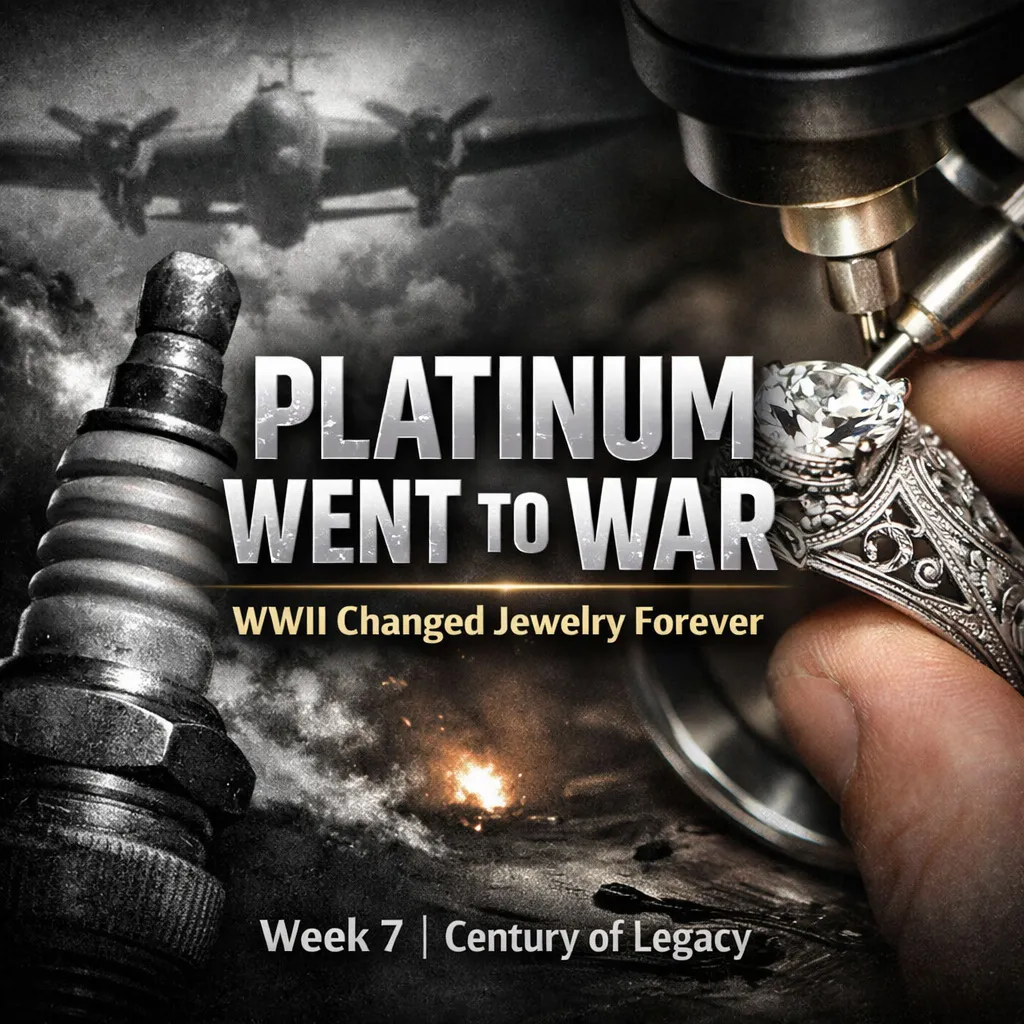
When Platinum Went to War
How WWII Changed Jewelry — and Shaped My Legacy
By Doug Meadows
Week 7 – A Century of Luxury & Legacy
As I began stepping from the 1930s into the 1940s in our family’s story, I expected to study the end of the Great Depression and the rise of World War II.
What I didn’t expect was to fall down a rabbit hole about platinum.
During World War II, platinum was classified as a strategic metal. Jewelers were restricted from using it. What had once been a prized, elegant white metal for fine jewelry suddenly became too valuable for civilian use.
Why?
Because platinum wasn’t just beautiful.
It was essential to winning a war.
Why the Government Needed Platinum
Platinum belongs to a family of six metals:
During WWII, platinum was used in:
I once heard about a jeweler who bought surplus WWII spark plugs because he knew the tiny tip on the end was platinum. He refined them and made a small fortune.
It makes you realize — sometimes opportunity hides in unexpected places.
My Personal Fascination with Platinum
I’ve always loved platinum.
When I was 19 years old, I drove from Michigan to Ohio to take a platinum bench class offered by GIA (Gemological Institute of America). I couldn’t afford a hotel room, so I worked a full day, drove late into the night, slept in my car at a rest area, freshened up in the morning, took the class, and drove home afterward.
That class changed me.
I was captivated by platinum’s working properties — its density, its strength, the way it handles stones. When I made my wife’s first engagement ring, I insisted on platinum prongs with an 18k yellow gold shank.
Over the years, I’ve updated her diamonds. But platinum has remained part of our story.
My dad once wore a simple platinum ring with a three-carat round diamond. I loved putting it on my finger as a kid. After it passed to my cousin, I recreated it for myself in platinum — a tribute to him and to the legacy we share.
Platinum isn’t just a metal to me.
It’s memory.
When Jewelers Had to Adapt
Imagine being a jeweler in the 1940s.
You’ve already survived the Great Depression. Now the government tells you that you can’t use platinum.
What do you do?
You adapt.
That’s when palladium saw a resurgence. White gold became the standard. Jewelers experimented with alloys and finishes. They innovated.
My grandfather, who began as a diamond setter and manufacturer, likely shifted more toward becoming what we call a trade shop — doing wholesale repair work for other jewelers.
My dad always said, “When times are tough, repair is plentiful.”
Instead of buying new, people fix what they have.
Adversity changes behavior. But it also sharpens craftsmanship.
White Gold, Palladium & the Platinum Family
White gold begins as pure 24k yellow gold. To make it white, we alloy it with metals like nickel, silver, and zinc.
The problem? It still has a yellow tinge.
So we coat it with rhodium — another member of the platinum family — to make it bright white. But rhodium plating wears off over time.
Palladium became popular during platinum shortages and again between 2008–2014 due to cost differences. While it has benefits, I’m not a fan of it as a standalone metal. It oxidizes quickly and can be brittle during repairs.
However, I do appreciate palladium when used as an alloy in white gold — especially for clients with nickel allergies. In Europe, nickel is illegal in white gold, so palladium alloys are standard.
When we work with platinum today, we rarely use it in its pure state. We alloy it with metals like ruthenium or iridium for strength. I personally prefer ruthenium — it offers a beautiful balance of durability and workability.
How Jewelry Was Made Then — And Now
During the early 1900s, die striking became a premium method of jewelry manufacturing.
Large presses compressed sheets of metal into detailed forms, producing dense, durable, beautifully crisp pieces. Often, filigree rings were die struck in halves, assembled, and then hand engraved.
Die striking is still used today, though less frequently due to cost and tooling requirements. Companies like Whitehouse Brothers (founded in 1898) and Jabel (founded in 1916) continue to carry forward elements of that tradition.
Other methods include:
But craftsmanship still matters.
The Craft Lives On at David Douglas Diamonds
Today in our store:
Hand engraving. Die struck components. Custom CAD. American-made lines.
Very few stores offer that depth of skill under one roof.
And I don’t take that for granted.
God has brought us the right people at the right times.
Legacy Under Pressure
The 1920s were a heyday for jewelry.
The 1930s tested survival.
The 1940s demanded adaptation.
Through it all, craftsmen endured.
They changed metals. They changed techniques. They repaired instead of replaced. They learned. They evolved.
And that spirit of adaptation — under pressure — is part of our family’s DNA.
Platinum may have gone to war.
But craftsmanship never did.
Next week, my daughter and I will be traveling Route 66, and I’ll be filming from the road as we continue this journey through history.
Thanks for walking through it with me.
— Doug Meadows
Founder, Visionary & Hero Maker
David Douglas Diamonds
How WWII Changed Jewelry — and Shaped My Legacy
By Doug Meadows
Week 7 – A Century of Luxury & Legacy
As I began stepping from the 1930s into the 1940s in our family’s story, I expected to study the end of the Great Depression and the rise of World War II.
What I didn’t expect was to fall down a rabbit hole about platinum.
During World War II, platinum was classified as a strategic metal. Jewelers were restricted from using it. What had once been a prized, elegant white metal for fine jewelry suddenly became too valuable for civilian use.
Why?
Because platinum wasn’t just beautiful.
It was essential to winning a war.
Why the Government Needed Platinum
Platinum belongs to a family of six metals:
- Platinum
- Palladium
- Rhodium
- Ruthenium
- Iridium
- Osmium
During WWII, platinum was used in:
- Chemical and petroleum refining
- Production of high-octane aviation fuel
- Nitric acid manufacturing (essential for explosives)
- Synthetic rubber production
- Precision electrical components
- Aircraft spark plugs
I once heard about a jeweler who bought surplus WWII spark plugs because he knew the tiny tip on the end was platinum. He refined them and made a small fortune.
It makes you realize — sometimes opportunity hides in unexpected places.
My Personal Fascination with Platinum
I’ve always loved platinum.
When I was 19 years old, I drove from Michigan to Ohio to take a platinum bench class offered by GIA (Gemological Institute of America). I couldn’t afford a hotel room, so I worked a full day, drove late into the night, slept in my car at a rest area, freshened up in the morning, took the class, and drove home afterward.
That class changed me.
I was captivated by platinum’s working properties — its density, its strength, the way it handles stones. When I made my wife’s first engagement ring, I insisted on platinum prongs with an 18k yellow gold shank.
Over the years, I’ve updated her diamonds. But platinum has remained part of our story.
My dad once wore a simple platinum ring with a three-carat round diamond. I loved putting it on my finger as a kid. After it passed to my cousin, I recreated it for myself in platinum — a tribute to him and to the legacy we share.
Platinum isn’t just a metal to me.
It’s memory.
When Jewelers Had to Adapt
Imagine being a jeweler in the 1940s.
You’ve already survived the Great Depression. Now the government tells you that you can’t use platinum.
What do you do?
You adapt.
That’s when palladium saw a resurgence. White gold became the standard. Jewelers experimented with alloys and finishes. They innovated.
My grandfather, who began as a diamond setter and manufacturer, likely shifted more toward becoming what we call a trade shop — doing wholesale repair work for other jewelers.
My dad always said, “When times are tough, repair is plentiful.”
Instead of buying new, people fix what they have.
Adversity changes behavior. But it also sharpens craftsmanship.
White Gold, Palladium & the Platinum Family
White gold begins as pure 24k yellow gold. To make it white, we alloy it with metals like nickel, silver, and zinc.
The problem? It still has a yellow tinge.
So we coat it with rhodium — another member of the platinum family — to make it bright white. But rhodium plating wears off over time.
Palladium became popular during platinum shortages and again between 2008–2014 due to cost differences. While it has benefits, I’m not a fan of it as a standalone metal. It oxidizes quickly and can be brittle during repairs.
However, I do appreciate palladium when used as an alloy in white gold — especially for clients with nickel allergies. In Europe, nickel is illegal in white gold, so palladium alloys are standard.
When we work with platinum today, we rarely use it in its pure state. We alloy it with metals like ruthenium or iridium for strength. I personally prefer ruthenium — it offers a beautiful balance of durability and workability.
How Jewelry Was Made Then — And Now
During the early 1900s, die striking became a premium method of jewelry manufacturing.
Large presses compressed sheets of metal into detailed forms, producing dense, durable, beautifully crisp pieces. Often, filigree rings were die struck in halves, assembled, and then hand engraved.
Die striking is still used today, though less frequently due to cost and tooling requirements. Companies like Whitehouse Brothers (founded in 1898) and Jabel (founded in 1916) continue to carry forward elements of that tradition.
Other methods include:
- Hand fabrication (forming wire and sheet by hand)
- Casting (using wax or resin models)
- Modern CAD design and 3D printing
But craftsmanship still matters.
The Craft Lives On at David Douglas Diamonds
Today in our store:
- Abby hand fabricates sterling silver jewelry with a unique artistic touch.
- Haley is an exceptional engraver and stone setter. She has been accepted twice into the prestigious GRS Grand Masters class — a true honor.
- My son Joseph handles our CAD design work and has won national rendering awards.
- All of our Design Team have won awards for their designing skills
Hand engraving. Die struck components. Custom CAD. American-made lines.
Very few stores offer that depth of skill under one roof.
And I don’t take that for granted.
God has brought us the right people at the right times.
Legacy Under Pressure
The 1920s were a heyday for jewelry.
The 1930s tested survival.
The 1940s demanded adaptation.
Through it all, craftsmen endured.
They changed metals. They changed techniques. They repaired instead of replaced. They learned. They evolved.
And that spirit of adaptation — under pressure — is part of our family’s DNA.
Platinum may have gone to war.
But craftsmanship never did.
Next week, my daughter and I will be traveling Route 66, and I’ll be filming from the road as we continue this journey through history.
Thanks for walking through it with me.
— Doug Meadows
Founder, Visionary & Hero Maker
David Douglas Diamonds