
A Century of Luxury & Legacy
The Surprising History of Synthetic Gems and Diamonds
Published: Jun 14, 2026
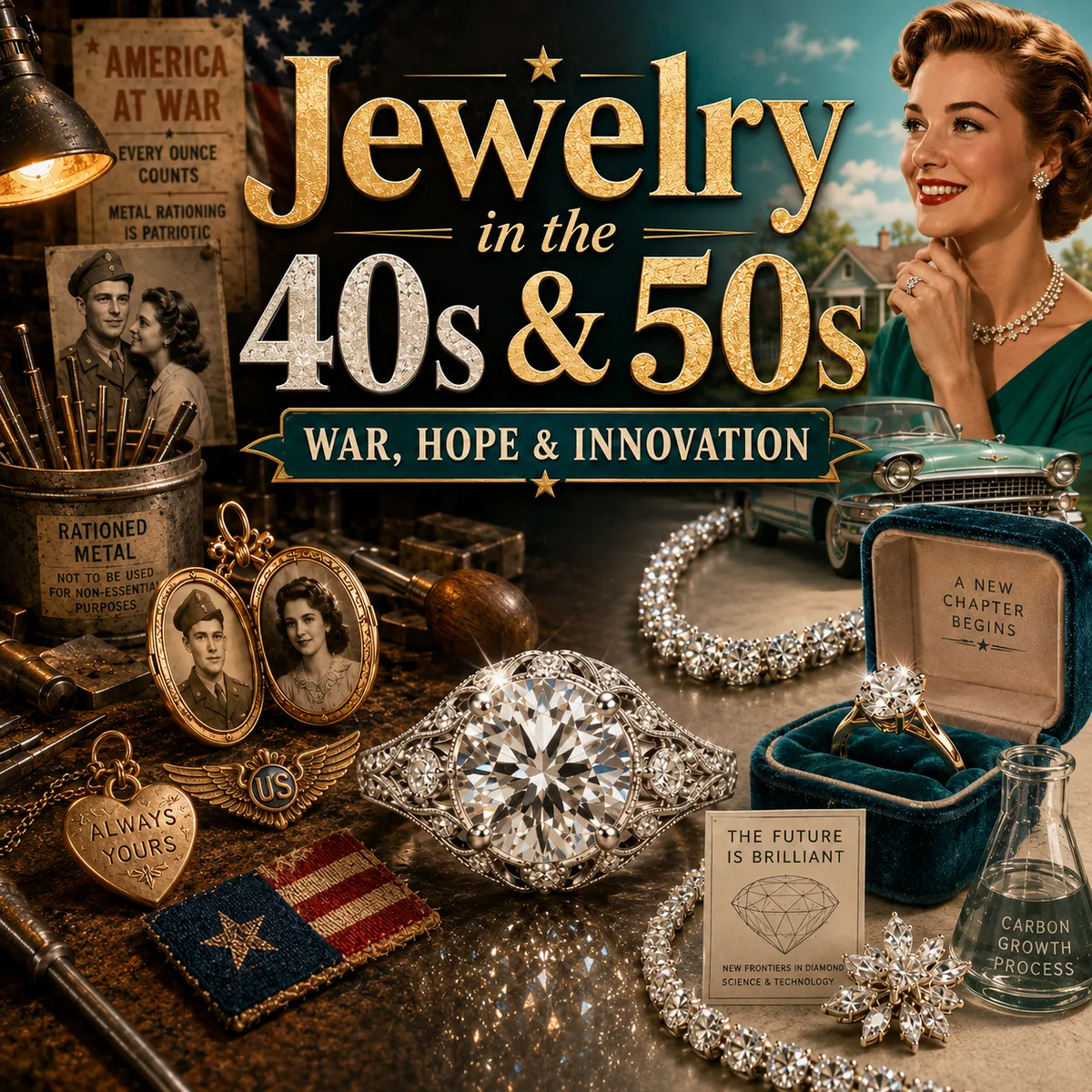
From Wartime Sacrifice to Jewelry’s New Beginning
When I look back at the 1940s and 1950s, I cannot help but think about what my grandfather, my dad, and my uncles must have lived through.
This part of our journey through a century of luxury and legacy is about much more than jewelry. It is about hardship, hope, creativity, family, and the way people find a way to keep going when life changes around them.
The 1940s were difficult years for so many people. World War II affected nearly every part of life. Families had loved ones serving overseas. Women entered the workforce in greater numbers. Food, gasoline, and metals were rationed. People were simply trying to hold on to hope and make it through.
For the jewelry industry, those years brought real challenges. Jewelry production nearly came to a stop in many ways because the materials jewelers needed were hard to get. Precious metals and other supplies were directed toward the war effort, and jewelers had to adapt.
That is one thing I have always admired about people in our industry. Jewelers are creative people. When one door closes, they figure out another way to serve their customers.
For my grandfather, one of those pivots may have been the service and repair side of the business. When you cannot manufacture the way you once did, you repair what people already have. You restore it. You make it usable again. You help someone hold on to something meaningful.
Even during wartime, jewelry still had a purpose.
People wore sweetheart jewelry, victory pins, lockets, military pins, and service flags. These were not just pieces of metal or stones. They were reminders of someone serving far from home. They were a way to remember, honor, and hope.
I have often said that jewelry is a stone of remembrance. That is especially true during difficult times. A piece of jewelry can carry a story, a person, a promise, or a memory forward.
Then the 1950s arrived, and America began to change again.
Soldiers came home. The GI Bill opened doors. New homes were built. Suburbs began to grow. Families expanded during the baby boom, which I happen to be a product of. Television became part of everyday life, and even cars became more than transportation. They became a statement of style and optimism.
People wanted to celebrate again.
That was a wonderful time for the jewelry industry. Engagement rings, wedding bands, anniversary gifts, birthday gifts, mother’s rings, and pieces to celebrate the birth of a child all became part of the story. After years of sacrifice and uncertainty, people were ready to mark life’s moments again.
Jewelry became part of the legacy people wanted to create.
“This was my grandmother’s.”
“This was my great-grandmother’s.”
“This is something I want you to have someday.”
That kind of thinking is one reason jewelry has always mattered. It is not just about what a piece is made of. It is about the person who wore it, the occasion it represented, and the story that continues long after the gift was given.
The 1950s also gave us one of the most famous phrases in diamond history: “A Diamond Is Forever.”
That message connected with people because diamonds and jewelry have always represented something lasting. Love, commitment, family, milestones, and memories are things people want to preserve. A beautiful piece of jewelry can become the physical reminder of those moments.
Another interesting part of this era is the early story of synthetic gemstones and lab-grown diamonds.
Many people think lab-grown diamonds are a brand-new idea, but the history goes back much further. In 1954, General Electric created what was then called a synthetic diamond using a process known as high pressure, high temperature. At that time, those diamonds were primarily used for industrial purposes, such as diamond bits and tools.
Over the decades, technology continued to improve. Early lab-grown diamonds were often small and not especially clear. Some had blue, green, or yellow tones. Later developments, including carbon vapor deposition, helped create better-quality diamonds that look much more like the lab-grown diamonds people see today.
Synthetic gemstones were also common in earlier jewelry than many people realize.
Customers will sometimes bring in a piece that belonged to their grandmother or great-grandmother and assume every stone must be natural because it is old. But synthetic gemstones have been around since the late 1800s and early 1900s. Many vintage pieces used synthetic rubies, sapphires, and other colored stones, even when they were set in real gold or platinum and paired with natural diamonds.
That does not take away from the story of the piece. It simply helps us understand it better.
Sometimes the family story says, “This was Great-Grandmother’s valuable ruby ring,” and the gemstone turns out to be synthetic. The financial value may be different than expected, but the sentimental value can still be priceless. The story, the memories, and the connection to the person who wore it still matter.
As I think about the 1940s and 1950s, I also think about my dad and uncle. Like many people who grow up in a family business, they both tried to do something different before eventually finding their way back to jewelry.
I did the same thing.
After high school, I thought I might go work in a factory in Detroit and make big money. I did that for a little while, but after ending up with a hernia, I was laid up for several weeks. I could not do the factory work, but I could sit at a jeweler’s bench. That experience helped point me back toward the jewelry industry.
The more I learned, the more I enjoyed it. Then I got introduced to the retail side of the business, and it became even more fun. I began to see that this was never just about selling diamonds or repairing jewelry. It was about people and the moments they wanted to celebrate.
I am grateful my dad and uncle came back to the business. I am grateful I stayed in it. And I am grateful that Joseph is here with me today, helping carry the story forward.
That is what a century of legacy and luxury means to me.
It is not simply surviving changing times. It is finding ways to serve people through them. It is adapting when circumstances force you to change. It is honoring what came before while continuing to build something worth passing on.
The 1940s taught us resilience.
The 1950s reminded us to celebrate.
And jewelry, as it has always done, helped people remember what mattered most.
When I look back at the 1940s and 1950s, I cannot help but think about what my grandfather, my dad, and my uncles must have lived through.
This part of our journey through a century of luxury and legacy is about much more than jewelry. It is about hardship, hope, creativity, family, and the way people find a way to keep going when life changes around them.
The 1940s were difficult years for so many people. World War II affected nearly every part of life. Families had loved ones serving overseas. Women entered the workforce in greater numbers. Food, gasoline, and metals were rationed. People were simply trying to hold on to hope and make it through.
For the jewelry industry, those years brought real challenges. Jewelry production nearly came to a stop in many ways because the materials jewelers needed were hard to get. Precious metals and other supplies were directed toward the war effort, and jewelers had to adapt.
That is one thing I have always admired about people in our industry. Jewelers are creative people. When one door closes, they figure out another way to serve their customers.
For my grandfather, one of those pivots may have been the service and repair side of the business. When you cannot manufacture the way you once did, you repair what people already have. You restore it. You make it usable again. You help someone hold on to something meaningful.
Even during wartime, jewelry still had a purpose.
People wore sweetheart jewelry, victory pins, lockets, military pins, and service flags. These were not just pieces of metal or stones. They were reminders of someone serving far from home. They were a way to remember, honor, and hope.
I have often said that jewelry is a stone of remembrance. That is especially true during difficult times. A piece of jewelry can carry a story, a person, a promise, or a memory forward.
Then the 1950s arrived, and America began to change again.
Soldiers came home. The GI Bill opened doors. New homes were built. Suburbs began to grow. Families expanded during the baby boom, which I happen to be a product of. Television became part of everyday life, and even cars became more than transportation. They became a statement of style and optimism.
People wanted to celebrate again.
That was a wonderful time for the jewelry industry. Engagement rings, wedding bands, anniversary gifts, birthday gifts, mother’s rings, and pieces to celebrate the birth of a child all became part of the story. After years of sacrifice and uncertainty, people were ready to mark life’s moments again.
Jewelry became part of the legacy people wanted to create.
“This was my grandmother’s.”
“This was my great-grandmother’s.”
“This is something I want you to have someday.”
That kind of thinking is one reason jewelry has always mattered. It is not just about what a piece is made of. It is about the person who wore it, the occasion it represented, and the story that continues long after the gift was given.
The 1950s also gave us one of the most famous phrases in diamond history: “A Diamond Is Forever.”
That message connected with people because diamonds and jewelry have always represented something lasting. Love, commitment, family, milestones, and memories are things people want to preserve. A beautiful piece of jewelry can become the physical reminder of those moments.
Another interesting part of this era is the early story of synthetic gemstones and lab-grown diamonds.
Many people think lab-grown diamonds are a brand-new idea, but the history goes back much further. In 1954, General Electric created what was then called a synthetic diamond using a process known as high pressure, high temperature. At that time, those diamonds were primarily used for industrial purposes, such as diamond bits and tools.
Over the decades, technology continued to improve. Early lab-grown diamonds were often small and not especially clear. Some had blue, green, or yellow tones. Later developments, including carbon vapor deposition, helped create better-quality diamonds that look much more like the lab-grown diamonds people see today.
Synthetic gemstones were also common in earlier jewelry than many people realize.
Customers will sometimes bring in a piece that belonged to their grandmother or great-grandmother and assume every stone must be natural because it is old. But synthetic gemstones have been around since the late 1800s and early 1900s. Many vintage pieces used synthetic rubies, sapphires, and other colored stones, even when they were set in real gold or platinum and paired with natural diamonds.
That does not take away from the story of the piece. It simply helps us understand it better.
Sometimes the family story says, “This was Great-Grandmother’s valuable ruby ring,” and the gemstone turns out to be synthetic. The financial value may be different than expected, but the sentimental value can still be priceless. The story, the memories, and the connection to the person who wore it still matter.
As I think about the 1940s and 1950s, I also think about my dad and uncle. Like many people who grow up in a family business, they both tried to do something different before eventually finding their way back to jewelry.
I did the same thing.
After high school, I thought I might go work in a factory in Detroit and make big money. I did that for a little while, but after ending up with a hernia, I was laid up for several weeks. I could not do the factory work, but I could sit at a jeweler’s bench. That experience helped point me back toward the jewelry industry.
The more I learned, the more I enjoyed it. Then I got introduced to the retail side of the business, and it became even more fun. I began to see that this was never just about selling diamonds or repairing jewelry. It was about people and the moments they wanted to celebrate.
I am grateful my dad and uncle came back to the business. I am grateful I stayed in it. And I am grateful that Joseph is here with me today, helping carry the story forward.
That is what a century of legacy and luxury means to me.
It is not simply surviving changing times. It is finding ways to serve people through them. It is adapting when circumstances force you to change. It is honoring what came before while continuing to build something worth passing on.
The 1940s taught us resilience.
The 1950s reminded us to celebrate.
And jewelry, as it has always done, helped people remember what mattered most.