
A Century of Luxury & Legacy
The Tools That Shaped a Century of Diamond Setting
Published: Mar 8, 2026
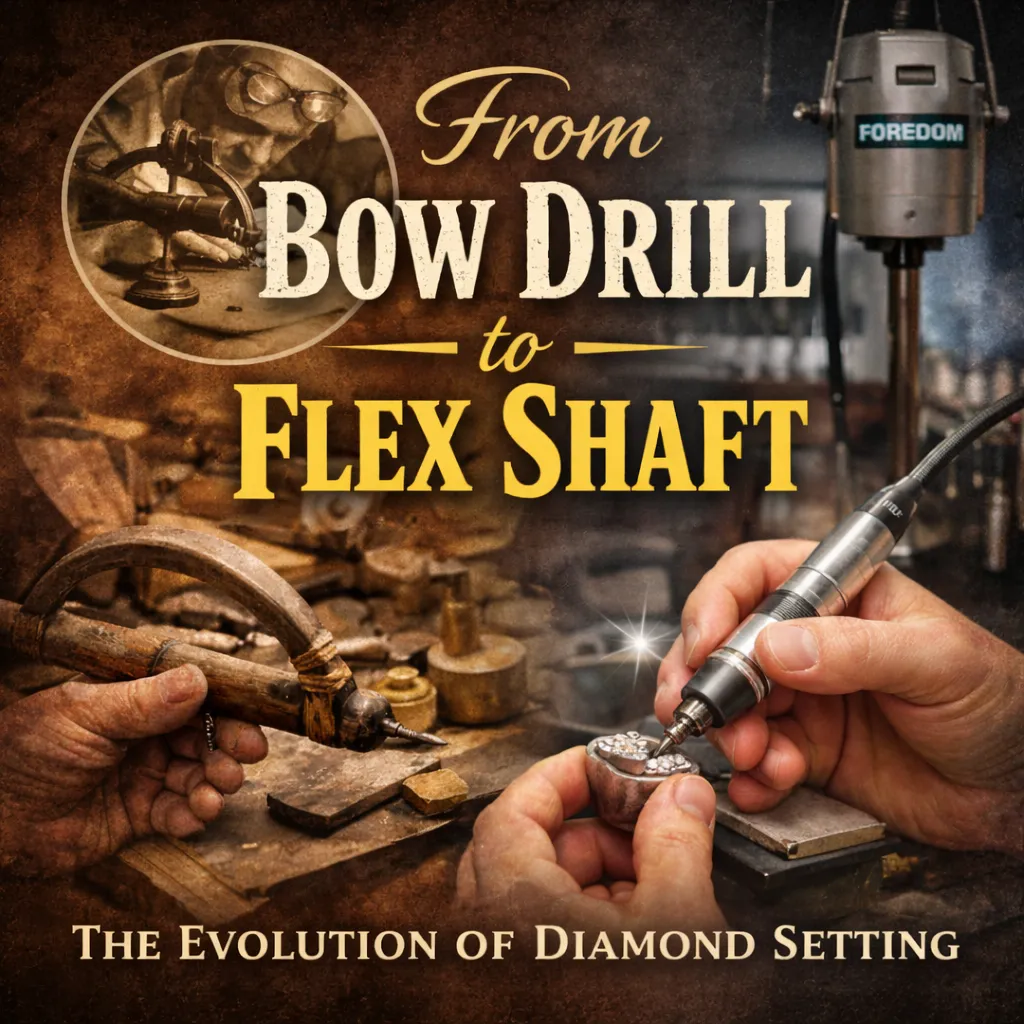
From Bow Drills to Micro Motors: The Evolution of Diamond Setting
Part of the “A Century of Legacy & Luxury” Series
When I think about the story of our company, I often find myself reflecting on the tools and craftsmanship that shaped it. My grandfather began his journey in the jewelry industry in 1926 as a diamond setter and manufacturer. Sitting at a jeweler’s bench nearly a century ago required patience, steady hands, and a deep understanding of both metal and stone.
Today, many of the tools we use have evolved dramatically, but the fundamental art of setting a diamond remains rooted in those early techniques.
The Tools of a Diamond Setter
At its core, diamond setting begins with a simple goal: creating a precise seat in metal so a gemstone or diamond can be securely and beautifully held in place.
In the early days of the trade, a jeweler might start with a solid sheet of gold and carefully carve the design from that single piece of metal. To begin the process, a small hole would be drilled where the gemstone or diamond would eventually sit.
A hundred years ago, that hole was often drilled using a tool called a bow drill.
The Bow Drill
If you walked into a jewelry shop in the early 1900s, you might see a jeweler using what looked like a small wooden bow with a string wrapped around a spinning shaft.
By moving the bow up and down, the jeweler could rotate the drill bit and slowly drill into the metal. It was simple, effective, and completely powered by the jeweler’s hands.
It required patience and skill, but it worked.
The Arrival of the Flex Shaft
In 1922, a company called Foredom introduced a revolutionary tool to the jewelry industry: the flex shaft.
This system used a small motor, roughly the size of a coffee can, that spun a flexible shaft about three to four feet long. At the end of that shaft was a handpiece that held drill bits and setting burrs.
The jeweler controlled the speed using a foot pedal, much like a gas pedal on a car. The harder you pressed, the faster the tool spun.
This innovation transformed the jeweler’s bench. Suddenly, jewelers could work faster, more efficiently, and with greater control.
Interestingly, many of the tools used by jewelers share similarities with those used in the dental industry. Both professions require working with extremely small surfaces and precise instruments. In fact, gold was once commonly used in dentistry for crowns, further linking the two trades.
What’s remarkable is that even today, nearly a century later, the basic design of the Foredom flex shaft has hardly changed. It still works, and it’s still one of the most widely used tools on a jeweler’s bench.
Modern Innovations: Micro Motors
While the flex shaft is still common, modern jewelers often use micro motors for even greater precision.
Instead of a remote motor connected by a shaft, a micro motor places the motor directly inside the handpiece. A control box on the bench allows the jeweler to adjust speed and torque with incredible accuracy.
This is especially important when cutting a seat, the tiny groove that holds a diamond securely in place.
Diamond setters often need very low speeds with high torque to achieve perfect control. Modern micro motors allow that level of precision in ways early jewelers could only dream of.
Cutting the Seat
Once the initial hole is drilled, the next step is cutting the seat for the stone.
Historically, this was done using hand gravers, small cutting tools pushed by hand. Jewelers would carefully carve away metal until the diamond fit perfectly.
Sometimes a fine jeweler’s saw blade would also be used to rough out the area before finishing with a graver.
When I look at jewelry from the early 1900s, pieces from the 1920s or 1930s, the craftsmanship absolutely amazes me. The amount of time and skill required to produce those pieces was extraordinary.
It always breaks my heart a little when someone inherits a piece from that era and decides it isn’t their style. Sometimes those pieces get melted down or redesigned, and I can’t help but think about the hours of work that went into them.
Pneumatic Gravers and Modern Precision
Today, many jewelers still use gravers, but they’ve been enhanced with pneumatic systems.
Instead of pushing the tool by hand, compressed air powers a rapid pulsing motion that allows the graver to cut smoothly and consistently.
We’ve also greatly improved how we sharpen our tools.
Years ago, jewelers relied on Arkansas sharpening stones. These were typically about six inches long and lubricated with oil while sharpening. Jewelers would polish their gravers to a mirror finish using simple techniques, sometimes even dipping the tip in wintergreen oil with cotton to produce a bright, clean cut known as a bright cut.
Today, we have diamond sharpening wheels and precision jigs that allow us to achieve exact angles with incredible accuracy.
The Many Types of Setting Burrs
Another important innovation in diamond setting was the development of specialized burrs.
These are cutting tools shaped to match the bottom of various gemstones and diamonds.
Different stones, and different cutting styles, require different angles. As a result, jewelers use a wide variety of burr shapes, including:
One lesson I learned early in my career was humility. When you grow up learning a craft in a family environment, it’s easy to think the way you were taught is the only and right way.
But as I began working with other jewelers and traveling, I discovered there are many ways to accomplish the same goal. Some jewelers work with very simple tools yet produce extraordinary results.
It’s always humbling to see.
Creating the Prongs
Once the seat is cut and the diamond is placed, the next step is securing the stone.
This is done by forming prongs that hold the diamond in place.
Sometimes the prongs are built into the design from the start, as with a classic solitaire engagement ring. Other times, especially when working from a solid sheet of metal, the jeweler must cut away the surrounding metal to create the prongs by hand.
Today, computer design tools like CAD/CAM can create much of this structure in advance, making production faster and more consistent.
But historically, every prong was shaped by hand.
The Rise of Mass Production
Modern jewelry manufacturing sometimes uses a method called stone-in-place casting.
In this process, stones are set directly into a wax model before casting. The wax is then melted away during the investment casting process, leaving the stones embedded in the finished metal.
While efficient for mass production, this method can create challenges later when repairs are needed. From a bench jeweler’s perspective, it can be much harder to properly service or reset stones that were cast this way.
Personally, I still appreciate the traditional approach where each stone is individually set and polished.
The Legacy of Craftsmanship
One of the greatest joys of my career has been seeing the next generation of jewelers embrace this craft.
Our master diamond setter, Haley, has an incredible passion for stone setting. She is constantly learning new techniques and refining her skills, combining traditional craftsmanship with modern technology.
Sometimes the most beautiful details of a piece of jewelry are hidden on the back, areas the wearer may never even see. Yet great setters still take the time to make those areas perfect.
It becomes a kind of signature of craftsmanship.
Why Quality Still Matters
As I reflect on the legacy of this craft, I’m reminded how important quality is.
Jewelry isn’t just another product, it carries emotional meaning and memories.
I sometimes see people spend hundreds of dollars on a single dinner but hesitate when purchasing jewelry for a milestone like a daughter’s birthday. Yet that piece of jewelry might be cherished for decades.
Poorly made jewelry often doesn’t last. Ten years later it may be worn out or falling apart, leaving nothing for us to repair.
But well-made jewelry, crafted with care and skill, can last for generations.
A Century of Legacy and Luxury
Over the past hundred years, the tools have evolved from bow drills and hand gravers to flex shafts, micro motors, and pneumatic systems.
But the heart of the craft remains the same.
It’s still about skill, patience, and pride in the work.
And that legacy, passed down from my grandfather’s bench in 1926 to the jewelers working today, is something I’m incredibly grateful to be a part of.
Doug Meadows
Founder & Visionary
David Douglas Diamonds & Jewelry
Celebrating 100 Years of Legacy & Luxury (1926–2026)
Part of the “A Century of Legacy & Luxury” Series
When I think about the story of our company, I often find myself reflecting on the tools and craftsmanship that shaped it. My grandfather began his journey in the jewelry industry in 1926 as a diamond setter and manufacturer. Sitting at a jeweler’s bench nearly a century ago required patience, steady hands, and a deep understanding of both metal and stone.
Today, many of the tools we use have evolved dramatically, but the fundamental art of setting a diamond remains rooted in those early techniques.
The Tools of a Diamond Setter
At its core, diamond setting begins with a simple goal: creating a precise seat in metal so a gemstone or diamond can be securely and beautifully held in place.
In the early days of the trade, a jeweler might start with a solid sheet of gold and carefully carve the design from that single piece of metal. To begin the process, a small hole would be drilled where the gemstone or diamond would eventually sit.
A hundred years ago, that hole was often drilled using a tool called a bow drill.
The Bow Drill
If you walked into a jewelry shop in the early 1900s, you might see a jeweler using what looked like a small wooden bow with a string wrapped around a spinning shaft.
By moving the bow up and down, the jeweler could rotate the drill bit and slowly drill into the metal. It was simple, effective, and completely powered by the jeweler’s hands.
It required patience and skill, but it worked.
The Arrival of the Flex Shaft
In 1922, a company called Foredom introduced a revolutionary tool to the jewelry industry: the flex shaft.
This system used a small motor, roughly the size of a coffee can, that spun a flexible shaft about three to four feet long. At the end of that shaft was a handpiece that held drill bits and setting burrs.
The jeweler controlled the speed using a foot pedal, much like a gas pedal on a car. The harder you pressed, the faster the tool spun.
This innovation transformed the jeweler’s bench. Suddenly, jewelers could work faster, more efficiently, and with greater control.
Interestingly, many of the tools used by jewelers share similarities with those used in the dental industry. Both professions require working with extremely small surfaces and precise instruments. In fact, gold was once commonly used in dentistry for crowns, further linking the two trades.
What’s remarkable is that even today, nearly a century later, the basic design of the Foredom flex shaft has hardly changed. It still works, and it’s still one of the most widely used tools on a jeweler’s bench.
Modern Innovations: Micro Motors
While the flex shaft is still common, modern jewelers often use micro motors for even greater precision.
Instead of a remote motor connected by a shaft, a micro motor places the motor directly inside the handpiece. A control box on the bench allows the jeweler to adjust speed and torque with incredible accuracy.
This is especially important when cutting a seat, the tiny groove that holds a diamond securely in place.
Diamond setters often need very low speeds with high torque to achieve perfect control. Modern micro motors allow that level of precision in ways early jewelers could only dream of.
Cutting the Seat
Once the initial hole is drilled, the next step is cutting the seat for the stone.
Historically, this was done using hand gravers, small cutting tools pushed by hand. Jewelers would carefully carve away metal until the diamond fit perfectly.
Sometimes a fine jeweler’s saw blade would also be used to rough out the area before finishing with a graver.
When I look at jewelry from the early 1900s, pieces from the 1920s or 1930s, the craftsmanship absolutely amazes me. The amount of time and skill required to produce those pieces was extraordinary.
It always breaks my heart a little when someone inherits a piece from that era and decides it isn’t their style. Sometimes those pieces get melted down or redesigned, and I can’t help but think about the hours of work that went into them.
Pneumatic Gravers and Modern Precision
Today, many jewelers still use gravers, but they’ve been enhanced with pneumatic systems.
Instead of pushing the tool by hand, compressed air powers a rapid pulsing motion that allows the graver to cut smoothly and consistently.
We’ve also greatly improved how we sharpen our tools.
Years ago, jewelers relied on Arkansas sharpening stones. These were typically about six inches long and lubricated with oil while sharpening. Jewelers would polish their gravers to a mirror finish using simple techniques, sometimes even dipping the tip in wintergreen oil with cotton to produce a bright, clean cut known as a bright cut.
Today, we have diamond sharpening wheels and precision jigs that allow us to achieve exact angles with incredible accuracy.
The Many Types of Setting Burrs
Another important innovation in diamond setting was the development of specialized burrs.
These are cutting tools shaped to match the bottom of various gemstones and diamonds.
Different stones, and different cutting styles, require different angles. As a result, jewelers use a wide variety of burr shapes, including:
- Twist drills
- Ball burrs
- Inverted cone burrs
- Setting burrs shaped like the pavilion of a diamond
One lesson I learned early in my career was humility. When you grow up learning a craft in a family environment, it’s easy to think the way you were taught is the only and right way.
But as I began working with other jewelers and traveling, I discovered there are many ways to accomplish the same goal. Some jewelers work with very simple tools yet produce extraordinary results.
It’s always humbling to see.
Creating the Prongs
Once the seat is cut and the diamond is placed, the next step is securing the stone.
This is done by forming prongs that hold the diamond in place.
Sometimes the prongs are built into the design from the start, as with a classic solitaire engagement ring. Other times, especially when working from a solid sheet of metal, the jeweler must cut away the surrounding metal to create the prongs by hand.
Today, computer design tools like CAD/CAM can create much of this structure in advance, making production faster and more consistent.
But historically, every prong was shaped by hand.
The Rise of Mass Production
Modern jewelry manufacturing sometimes uses a method called stone-in-place casting.
In this process, stones are set directly into a wax model before casting. The wax is then melted away during the investment casting process, leaving the stones embedded in the finished metal.
While efficient for mass production, this method can create challenges later when repairs are needed. From a bench jeweler’s perspective, it can be much harder to properly service or reset stones that were cast this way.
Personally, I still appreciate the traditional approach where each stone is individually set and polished.
The Legacy of Craftsmanship
One of the greatest joys of my career has been seeing the next generation of jewelers embrace this craft.
Our master diamond setter, Haley, has an incredible passion for stone setting. She is constantly learning new techniques and refining her skills, combining traditional craftsmanship with modern technology.
Sometimes the most beautiful details of a piece of jewelry are hidden on the back, areas the wearer may never even see. Yet great setters still take the time to make those areas perfect.
It becomes a kind of signature of craftsmanship.
Why Quality Still Matters
As I reflect on the legacy of this craft, I’m reminded how important quality is.
Jewelry isn’t just another product, it carries emotional meaning and memories.
I sometimes see people spend hundreds of dollars on a single dinner but hesitate when purchasing jewelry for a milestone like a daughter’s birthday. Yet that piece of jewelry might be cherished for decades.
Poorly made jewelry often doesn’t last. Ten years later it may be worn out or falling apart, leaving nothing for us to repair.
But well-made jewelry, crafted with care and skill, can last for generations.
A Century of Legacy and Luxury
Over the past hundred years, the tools have evolved from bow drills and hand gravers to flex shafts, micro motors, and pneumatic systems.
But the heart of the craft remains the same.
It’s still about skill, patience, and pride in the work.
And that legacy, passed down from my grandfather’s bench in 1926 to the jewelers working today, is something I’m incredibly grateful to be a part of.
Doug Meadows
Founder & Visionary
David Douglas Diamonds & Jewelry
Celebrating 100 Years of Legacy & Luxury (1926–2026)