
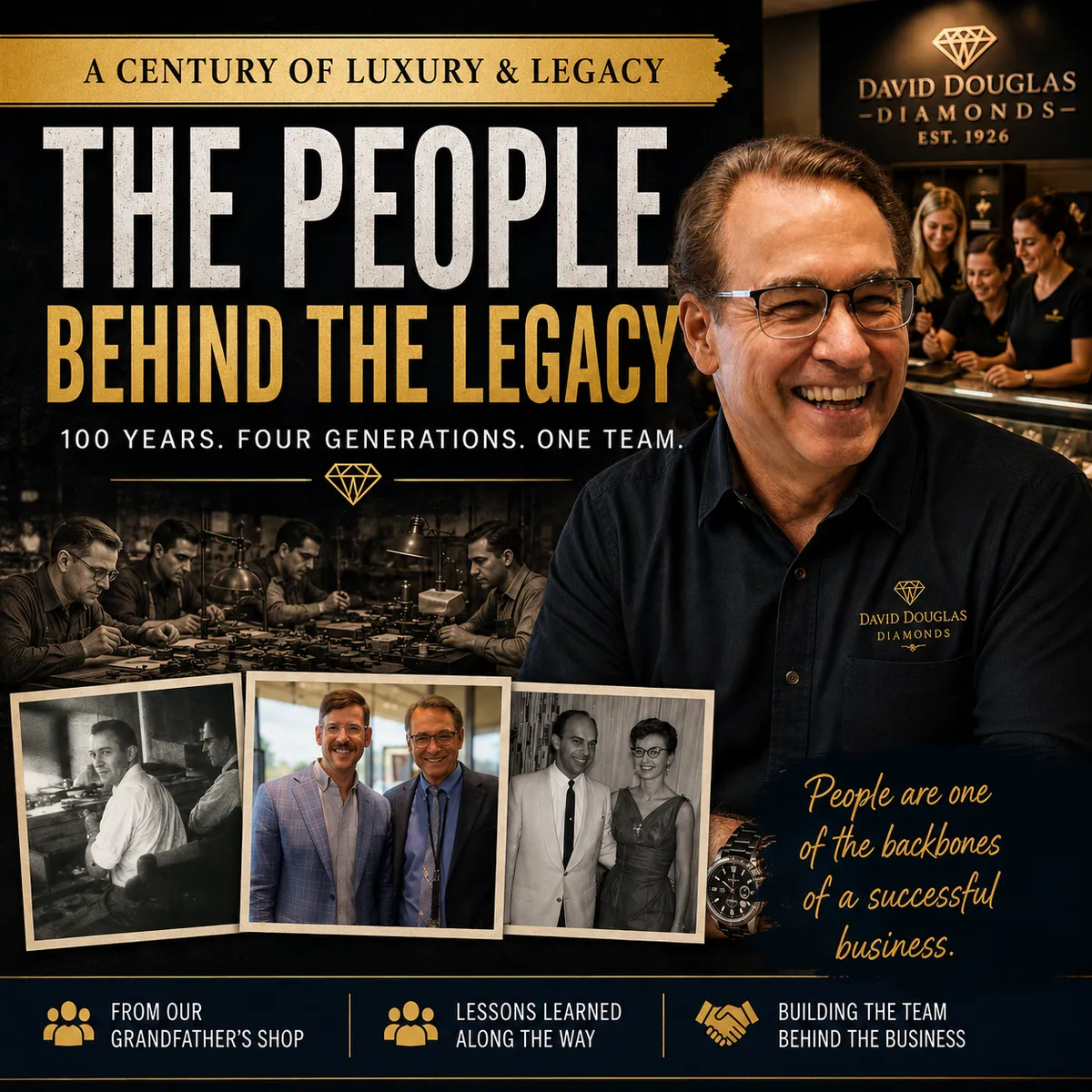
The People Behind the Legacy
This week I find myself in Lexington, Kentucky, at an RJO jewelry show, (Retail Jewelers Organization) and as often happens when I’m traveling, my mind starts wandering back through the years.
This time, I got thinking about employees.
Not just the people who work with us today, but the people who have worked alongside our family over the past 100 years.
As we celebrate a century of our family being in the jewelry business, I’ve spent a lot of time thinking about my grandfather, my dad, my uncles, my cousins, my brothers, and all the different chapters of the business.
But a family business is never built by family alone.
There are always people along the way who show up, lend their talents, solve problems, carry responsibility, and become part of the story.
What Was It Like in My Grandfather’s Shop?
I wish I knew more about the people who worked for my grandfather.
I remember hearing that he had several bench jewelers in his shop. There was also a woman who worked as a bench jeweler who, from everything I was told, was very talented.
But beyond bits and pieces like that, I really don’t know much.
That is one of the interesting things about looking back over 100 years. There are things you wish you would have asked.
Who were these people?
How long did they work there?
What was the atmosphere like?
How did my grandfather treat his employees?
What did they think of him?
I may never know all those answers.
I do know some stories about the way my grandfather worked.
My dad and uncle used to tell me that Grandpa would come into the shop in the morning, get things organized, and then disappear for much of the day.
Around three o’clock, he would come back.
He would ask what needed to be finished, sit down at the bench, knock out a bunch of work, and get everything ready to go out with the messenger or in the mail.
Apparently, that drove my dad crazy.
My dad would tell the story with a little frustration in his voice.
And yet, looking back now, I sometimes wonder if there was more going on than I understood.
Maybe Grandpa had his own way of running things.
Maybe my dad had his own ideas about how things should be done.
And that is part of a family business too.
Different generations.
Different personalities.
Different expectations.
Working With Family Isn’t Always Easy
One thing I have learned is that just because you are family doesn’t mean working together is going to be easy.
My dad and my uncle worked together, but they weren’t always especially fond of one another.
There was arguing in the shop.
There was tension.
When I eventually worked there, I felt it too.
It could be very uncomfortable.
And yet, that is also where I learned my trade.
That little shop, with all its imperfections, became my classroom.
My dad even told me once that he didn’t want me to get into the jewelry business.
He wanted me to go to college, get a good education, and find a good job somewhere else.
Funny how life works.
I graduated high school early, not because I was some brilliant student, but because I had watched my three older brothers and figured out how to make the school system work for me.
If there was a class that didn’t fit me well, I would ask the counselor what else I could take.
Instead of some of the traditional classes, I took things like welding, electronics, investments, real estate, typing, and speed reading.
My focus was pretty simple.
I wanted to get out of school and go to work.
Sometimes Life Makes the Decision for You
Like most kids, my earliest jobs were whatever I could find.
Our neighbor had five acres and horses, so my brother and I helped clean stalls and feed them.
Later, my brother Dave went to work in a Ford factory and was making what seemed like big money.
Naturally, I thought that sounded pretty good.
So I found myself a factory job too.
Then I got a hernia.
Back then, hernia surgery wasn’t quite the quick outpatient experience it can be today. I was going to be restricted from lifting for weeks.
I couldn’t do the factory work.
But I could lift a file.
I could sit at a jeweler’s bench.
So I went back to work with my dad.
And I stayed in the jewelry business.
Sometimes I look back at moments like that and wonder how much of our lives are shaped by little turns we could never have planned.
A setback becomes a redirection.
A closed door pushes us toward another one.
At the time, you don’t always see it.
Years later, you look back and think, “Well, maybe there was a reason for that after all.”
Learning From My Brothers
Working with my dad also meant working with my brothers.
I especially enjoyed working with Dave. He taught me a lot.
My brothers all went in different directions over time.
Donnie became a writer, working for newspapers, publications, and eventually the CDC. He is also an avid painter.
Danny was always the musician of the family. You can pretty much give him anything with strings and he can figure out how to play it. He even opened his own jewelry shop for a season called the Village Goldsmith before eventually working for another jeweler.
Dave stayed deeply involved in the jewelry side of the family story.
And then there was me.
Somehow, the kid whose father told him to stay out of the jewelry business ended up spending his life in it.
Nobody Handed Me a Leadership Manual
When I worked for my dad, there weren’t really employee reviews.
There wasn’t a clear system for raises.
You usually didn’t know when you were going to get one.
Eventually you would just ask.
There wasn’t a training manual explaining how to manage people.
There wasn’t a carefully designed leadership program.
So when my brother and I began growing our own businesses and suddenly had 10, 12, 15 employees, I found myself asking questions I had never really been taught how to answer.
How do you train somebody properly?
How do you conduct an employee review?
When do you give a raise?
How much should it be?
How do you know whether someone is doing a good job?
How do you help somebody improve when they aren’t?
What does an employee really cost the business?
How do you build a culture?
Those questions became even more complicated when we had multiple locations.
At one point we had Kaminski’s, a pawn shop in Woodstock, and a store in Norcross.
More locations meant more people.
More people meant more complexity.
And more complexity meant I had a lot more learning to do.
The Guy Who Knocked on the Door
Years later, when I was starting what I sometimes call the rebirth of David Douglas Diamonds, the business was tiny.
It was basically me and Jen.
I was trying to do the jewelry work and run the business at the same time.
I was overwhelmed.
One evening, I was working late and somebody started knocking on the door.
He was a little scruffy looking, and I was nervous.
You aren’t supposed to open a jewelry store door to strangers after hours.
But for some reason, I opened it.
He introduced himself and said his pastor had told him he should come talk to me.
He hated the job he had and wanted to work for me.
His name was James.
He had worked as a jeweler for another jewelry manufacturer and had experience.
I needed help badly.
The problem was that hiring someone meant taking on an expense that I wasn’t entirely sure I could afford.
I swallowed hard and took the chance.
It turned out to be one of those decisions that becomes part of the story of a business.
James became an incredible asset to the company.
He was a very talented jeweler.
More importantly, he became a great friend.
I really enjoyed working with him.
That knock on the door could have gone a hundred different ways.
Instead, it brought someone into my life and business who made a real difference.
Help Arrived Right Before Christmas
Another story I’ll never forget happened as Christmas was approaching.
Anyone who has spent time in the jewelry business knows what that means.
Christmas is our Super Bowl.
The work piles up.
Customers need things finished.
Deadlines get tighter.
Everybody is running.
We desperately needed help, but we were already close to the season.
How do you hire somebody in November and teach them everything they need to know quickly enough to actually be useful?
Around that same time, Hurricane Katrina had devastated Louisiana and displaced thousands of people.
One day, a young woman came into our store.
She explained that she was from Louisiana and had been temporarily displaced by the hurricane.
She asked if we could use some help.
It turned out she had been working in a jewelry store for years.
Even better, she already knew the point-of-sale software we used.
She could walk in and work.
It was almost plug-and-play.
We only had her for a relatively short period of time, but she was exactly what we needed at exactly the right moment.
I remember thinking it was a God send.
Sometimes people arrive in our lives for years.
Sometimes they arrive for only a season.
Either way, they can leave a lasting impact.
A Business Is Made of People
As David Douglas Diamonds continued growing, so did our staff.
And somewhere along the way, my thinking about employees began to change.
I started realizing that taking care of your staff isn’t something you figure out once and then you’re done.
It is constant.
People change.
Businesses change.
Circumstances change.
You learn.
Hopefully, you mature.
You get some things right.
You get some things wrong.
You apologize when you need to.
You adjust.
You listen.
And you keep learning.
Over the years, we have grown not only in the size of the business, but I think also in our maturity.
We have learned more about business.
But maybe even more importantly, we have learned more about people.
How to work with people.
How to encourage people.
How to help people grow.
How to recognize their strengths.
How to create opportunities.
How to appreciate what they bring to the table.
And I’m still learning.
The Backbone of the Business
When people look at a jewelry business, they see the diamonds.
They see the showcases.
They see the building.
They see the advertising.
They see the finished jewelry.
But behind all of that are people.
People answering phones.
People greeting customers.
People designing.
People repairing.
People setting stones.
People placing orders.
People solving problems.
People staying late.
People caring about a customer’s story.
People doing hundreds of little things that most people never see.
Looking back over our family’s journey, I’ve come to believe that our staff and our team have been one of the backbones of our success.
The name may be on the building.
The family may own the company.
But the legacy is built by far more people than the family whose name is on the door.
And for that, I am incredibly grateful.
As we continue celebrating this century of luxury and legacy, I think it is important that we remember those people too.
Because businesses don’t really build legacies.
People do.
And maybe next week, I’ll dig a little deeper into some of the lessons I’ve learned about building and taking care of a team.
There are plenty more stories to tell.
This week I find myself in Lexington, Kentucky, at an RJO jewelry show, (Retail Jewelers Organization) and as often happens when I’m traveling, my mind starts wandering back through the years.
This time, I got thinking about employees.
Not just the people who work with us today, but the people who have worked alongside our family over the past 100 years.
As we celebrate a century of our family being in the jewelry business, I’ve spent a lot of time thinking about my grandfather, my dad, my uncles, my cousins, my brothers, and all the different chapters of the business.
But a family business is never built by family alone.
There are always people along the way who show up, lend their talents, solve problems, carry responsibility, and become part of the story.
What Was It Like in My Grandfather’s Shop?
I wish I knew more about the people who worked for my grandfather.
I remember hearing that he had several bench jewelers in his shop. There was also a woman who worked as a bench jeweler who, from everything I was told, was very talented.
But beyond bits and pieces like that, I really don’t know much.
That is one of the interesting things about looking back over 100 years. There are things you wish you would have asked.
Who were these people?
How long did they work there?
What was the atmosphere like?
How did my grandfather treat his employees?
What did they think of him?
I may never know all those answers.
I do know some stories about the way my grandfather worked.
My dad and uncle used to tell me that Grandpa would come into the shop in the morning, get things organized, and then disappear for much of the day.
Around three o’clock, he would come back.
He would ask what needed to be finished, sit down at the bench, knock out a bunch of work, and get everything ready to go out with the messenger or in the mail.
Apparently, that drove my dad crazy.
My dad would tell the story with a little frustration in his voice.
And yet, looking back now, I sometimes wonder if there was more going on than I understood.
Maybe Grandpa had his own way of running things.
Maybe my dad had his own ideas about how things should be done.
And that is part of a family business too.
Different generations.
Different personalities.
Different expectations.
Working With Family Isn’t Always Easy
One thing I have learned is that just because you are family doesn’t mean working together is going to be easy.
My dad and my uncle worked together, but they weren’t always especially fond of one another.
There was arguing in the shop.
There was tension.
When I eventually worked there, I felt it too.
It could be very uncomfortable.
And yet, that is also where I learned my trade.
That little shop, with all its imperfections, became my classroom.
My dad even told me once that he didn’t want me to get into the jewelry business.
He wanted me to go to college, get a good education, and find a good job somewhere else.
Funny how life works.
I graduated high school early, not because I was some brilliant student, but because I had watched my three older brothers and figured out how to make the school system work for me.
If there was a class that didn’t fit me well, I would ask the counselor what else I could take.
Instead of some of the traditional classes, I took things like welding, electronics, investments, real estate, typing, and speed reading.
My focus was pretty simple.
I wanted to get out of school and go to work.
Sometimes Life Makes the Decision for You
Like most kids, my earliest jobs were whatever I could find.
Our neighbor had five acres and horses, so my brother and I helped clean stalls and feed them.
Later, my brother Dave went to work in a Ford factory and was making what seemed like big money.
Naturally, I thought that sounded pretty good.
So I found myself a factory job too.
Then I got a hernia.
Back then, hernia surgery wasn’t quite the quick outpatient experience it can be today. I was going to be restricted from lifting for weeks.
I couldn’t do the factory work.
But I could lift a file.
I could sit at a jeweler’s bench.
So I went back to work with my dad.
And I stayed in the jewelry business.
Sometimes I look back at moments like that and wonder how much of our lives are shaped by little turns we could never have planned.
A setback becomes a redirection.
A closed door pushes us toward another one.
At the time, you don’t always see it.
Years later, you look back and think, “Well, maybe there was a reason for that after all.”
Learning From My Brothers
Working with my dad also meant working with my brothers.
I especially enjoyed working with Dave. He taught me a lot.
My brothers all went in different directions over time.
Donnie became a writer, working for newspapers, publications, and eventually the CDC. He is also an avid painter.
Danny was always the musician of the family. You can pretty much give him anything with strings and he can figure out how to play it. He even opened his own jewelry shop for a season called the Village Goldsmith before eventually working for another jeweler.
Dave stayed deeply involved in the jewelry side of the family story.
And then there was me.
Somehow, the kid whose father told him to stay out of the jewelry business ended up spending his life in it.
Nobody Handed Me a Leadership Manual
When I worked for my dad, there weren’t really employee reviews.
There wasn’t a clear system for raises.
You usually didn’t know when you were going to get one.
Eventually you would just ask.
There wasn’t a training manual explaining how to manage people.
There wasn’t a carefully designed leadership program.
So when my brother and I began growing our own businesses and suddenly had 10, 12, 15 employees, I found myself asking questions I had never really been taught how to answer.
How do you train somebody properly?
How do you conduct an employee review?
When do you give a raise?
How much should it be?
How do you know whether someone is doing a good job?
How do you help somebody improve when they aren’t?
What does an employee really cost the business?
How do you build a culture?
Those questions became even more complicated when we had multiple locations.
At one point we had Kaminski’s, a pawn shop in Woodstock, and a store in Norcross.
More locations meant more people.
More people meant more complexity.
And more complexity meant I had a lot more learning to do.
The Guy Who Knocked on the Door
Years later, when I was starting what I sometimes call the rebirth of David Douglas Diamonds, the business was tiny.
It was basically me and Jen.
I was trying to do the jewelry work and run the business at the same time.
I was overwhelmed.
One evening, I was working late and somebody started knocking on the door.
He was a little scruffy looking, and I was nervous.
You aren’t supposed to open a jewelry store door to strangers after hours.
But for some reason, I opened it.
He introduced himself and said his pastor had told him he should come talk to me.
He hated the job he had and wanted to work for me.
His name was James.
He had worked as a jeweler for another jewelry manufacturer and had experience.
I needed help badly.
The problem was that hiring someone meant taking on an expense that I wasn’t entirely sure I could afford.
I swallowed hard and took the chance.
It turned out to be one of those decisions that becomes part of the story of a business.
James became an incredible asset to the company.
He was a very talented jeweler.
More importantly, he became a great friend.
I really enjoyed working with him.
That knock on the door could have gone a hundred different ways.
Instead, it brought someone into my life and business who made a real difference.
Help Arrived Right Before Christmas
Another story I’ll never forget happened as Christmas was approaching.
Anyone who has spent time in the jewelry business knows what that means.
Christmas is our Super Bowl.
The work piles up.
Customers need things finished.
Deadlines get tighter.
Everybody is running.
We desperately needed help, but we were already close to the season.
How do you hire somebody in November and teach them everything they need to know quickly enough to actually be useful?
Around that same time, Hurricane Katrina had devastated Louisiana and displaced thousands of people.
One day, a young woman came into our store.
She explained that she was from Louisiana and had been temporarily displaced by the hurricane.
She asked if we could use some help.
It turned out she had been working in a jewelry store for years.
Even better, she already knew the point-of-sale software we used.
She could walk in and work.
It was almost plug-and-play.
We only had her for a relatively short period of time, but she was exactly what we needed at exactly the right moment.
I remember thinking it was a God send.
Sometimes people arrive in our lives for years.
Sometimes they arrive for only a season.
Either way, they can leave a lasting impact.
A Business Is Made of People
As David Douglas Diamonds continued growing, so did our staff.
And somewhere along the way, my thinking about employees began to change.
I started realizing that taking care of your staff isn’t something you figure out once and then you’re done.
It is constant.
People change.
Businesses change.
Circumstances change.
You learn.
Hopefully, you mature.
You get some things right.
You get some things wrong.
You apologize when you need to.
You adjust.
You listen.
And you keep learning.
Over the years, we have grown not only in the size of the business, but I think also in our maturity.
We have learned more about business.
But maybe even more importantly, we have learned more about people.
How to work with people.
How to encourage people.
How to help people grow.
How to recognize their strengths.
How to create opportunities.
How to appreciate what they bring to the table.
And I’m still learning.
The Backbone of the Business
When people look at a jewelry business, they see the diamonds.
They see the showcases.
They see the building.
They see the advertising.
They see the finished jewelry.
But behind all of that are people.
People answering phones.
People greeting customers.
People designing.
People repairing.
People setting stones.
People placing orders.
People solving problems.
People staying late.
People caring about a customer’s story.
People doing hundreds of little things that most people never see.
Looking back over our family’s journey, I’ve come to believe that our staff and our team have been one of the backbones of our success.
The name may be on the building.
The family may own the company.
But the legacy is built by far more people than the family whose name is on the door.
And for that, I am incredibly grateful.
As we continue celebrating this century of luxury and legacy, I think it is important that we remember those people too.
Because businesses don’t really build legacies.
People do.
And maybe next week, I’ll dig a little deeper into some of the lessons I’ve learned about building and taking care of a team.
There are plenty more stories to tell.