
Skip to main contentSkip to footer
  • (770) 578-0598
  • Visit Our Showroom
  • Contact Us
  • Toggle Toolbar Search Menu
  • Toggle My Account Menu
    Login
    Forgot Password?

    Don’t have an account? Sign up now

  • Toggle My Wish List
  • Toggle Search Menu
  • Toggle My Wishlist
  • Toggle Shopping Cart Menu
David Douglas Diamonds & Jewelry logo
  • Dave Douglas Jewelry Logo
  • Engagement
    Engagement Rings
    Customizable Engagement RingsSemi-Set Engagement Rings
    Pre-set Engagement Rings
    Diamond Engagement RingsLab Diamond Engagement RingsShop all Pre-Set Engagement Rings
    Shop By Style
    SolitaireClassicUnique HaloThree StoneVintage
    Shop By Shape
    RoundOvalEmeraldPearCushionMarquise
    Featured
    Hidden Halo Engagement RingsGabriel & Co
    Education
    Engagement Ring BenefitsJewelry FinancingLifetime WarrantyDesign Concierge
    Browse All Engagement
  • Wedding
    Women
    Classic BandsModern BandsAnniversary BandsCurved BandsLuxe Bands
    Men
    Classic BandsModern Metal BandsMixed Metal BandsPattern BandsStones & Inlays
    Men's By Metal
    PlatinumYellow GoldWhite GoldRose Gold
    Modern Metals
    Damascus SteelMeteoriteTantalumZirconium
    Designers
    Chris Ploof DesignsAmmara StoneHeavy Stone Rings
    Wedding Day Jewelry
    Diamond StudsDiamond PendantsTennis Bracelets
    Build Your Wedding Band
    Menu image
  • Diamonds
    Natural Diamonds
    RoundPrincessEmeraldAsscherRadiantCushionOvalPearMarquiseHeart
    Canadamark Diamonds
    Specialty Diamonds
    Lab-Grown Diamonds
    Search Lab Diamonds8x Lab DiamondsSustainably Rated Lab Diamonds
    Featured
    Salt & Pepper DiamondsPre-Set Engagement Rings
    Education
    Diamond FinancingLifetime Diamond UpgradeAbout Lab Grown Diamonds
    Shop Loose Diamonds
  • Custom
    DESIGN YOUR OWN
    Custom Design JewelryWhat to ExpectClient Stories
    CUSTOM JEWELRY
    Custom Design GalleryAward Winning DesignsOur DesignersOur Process
    ONE OF A KIND
    Handmade JewelryHand Engraved JewelryVisit Us In Marietta
    Menu image
  • Jewelry
    SEARCH JEWELRY
    RingsEarringsNecklacesBraceletsWatchesShop All Jewelry
    SHOP BY STYLE
    Diamond Stud EarringsCocktail RingsTennis BraceletsHoop EarringsMen’s JewelryEstate Jewelry
    SERVICES
    Jewelry RepairCustom JewelrySell Your JewelryAppraisalsEar PiercingView All Services
    FEATURED
    Gabriel & Co. FashionShinola WatchesHandmade JewelryreDesign Your RingDavid Douglas Rewards
    Menu image
  • About
    ABOUT US
    Our StoryResponsible SourcingIn Our CommunityAward Winning
    SERVICES
    Jewelry RepairCustom JewelrySell Your JewelryAppraisalsEar PiercingView All Services
    STAY CONNECTED
    Contact UsDavid Douglas Blog
    STAY SOCIAL
    InstagramFacebook
    QUICK LINKS
    Return PolicyEngagement Ring BenefitsLifetime WarrantyJewelry FinancingDavid Douglas Rewards
    Menu image
  • (770) 578-0598
  • Visit Our Showroom
  • Contact Us
  • Toggle Toolbar Search Menu
  • Toggle My Account Menu
    Login
    Forgot Password?

    Don’t have an account? Sign up now

  • Toggle My Wish List
David Douglas Diamonds & Jewelry logo
Log In My Cart
  1. Home
  2. Blog
  3. Is It Possible to Set a Diamond Ablaze? These Scientists Deliver the Answer

Is It Possible to Set a Diamond Ablaze? These Scientists Deliver the Answer

Published: Nov 30
Is It Possible to Set a Diamond Ablaze? These Scientists Deliver the Answer
Author: 
Howard Cohen

Diamond sits alone atop the Mohs scale as the hardest naturally occurring material known to man. It is harder than a ruby, sapphire or emerald and has the ability to slice through steel like a hot knife through butter. The only substance that can scratch a diamond is another diamond.
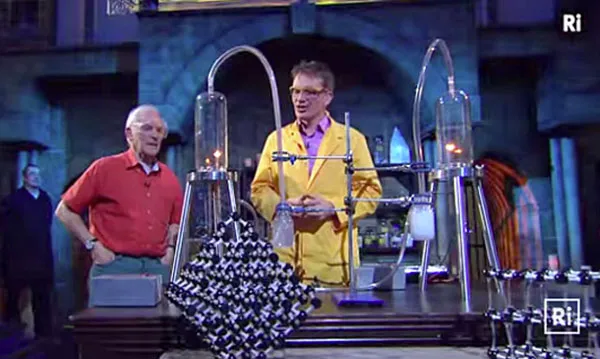
Under normal circumstances, diamonds truly are forever. But in the labs of the British Royal Institution, the famous De Beers ad slogan was put to the test.

Because a diamond is made from pure carbon, scientists have theorized since the 1700s that it should burn like other carbon materials, such as graphite or coal.

And, indeed, during the early 1770s, French chemist Antoine Lavoisier used two powerful lenses to magnify the sun’s rays directly onto a diamond. The diamond slowly disappeared and carbon dioxide gas accumulated, proving that the diamond was made from carbon.

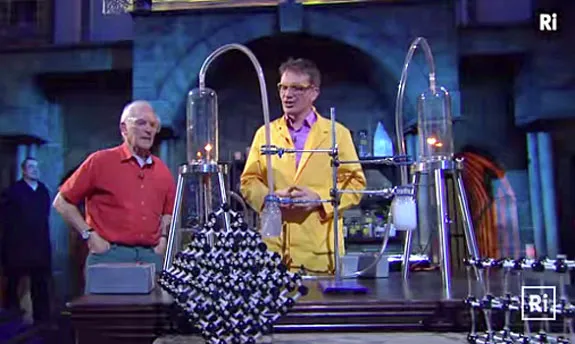
In the 2013 video, below, British scientist and author Peter Wothers enlisted the help of Nobel prize-winning chemist Sir Harry Kroto to demonstrate what it takes to get a diamond to burn. (Kroto passed away in 2016 at the age of 76.)
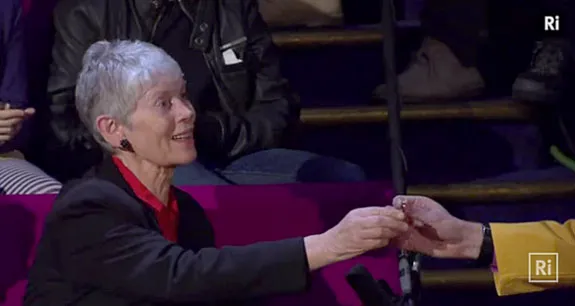
Wothers added a bit of drama and comic relief by using Kroto’s wife’s engagement diamond for the experiment. The viewer can see Kroto getting increasingly more uncomfortable as it becomes very clear that his wife’s diamond — under just the right conditions — has ignited.

In pure oxygen, diamonds can burn at 1320 degrees F. In normal conditions, the ignition occurs at about 1520 degrees F.

Wothers’ experiment was conducted in a chamber of pure oxygen. The resulting gases were collected in a tube leading to a beaker of limewater. The experiment anticipated that if the burning material contained carbon, the smoke would contain carbon dioxide. When the carbon dioxide was mixed into the limewater, it turned the mixture a milky white color — basically delivering calcium carbonate, an antacid used to calm a sour stomach.
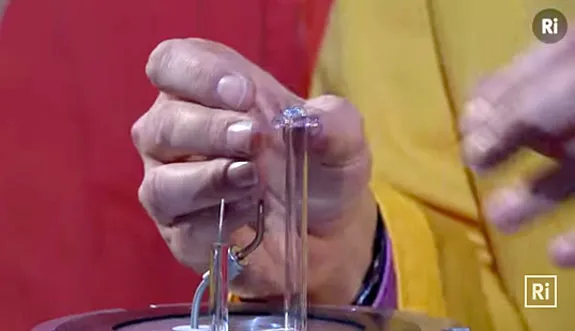
In his preliminary experiment, Wothers easily ignited a bit of graphite using a torch. Then he upped the ante by doing the exact same experiment using the Kroto engagement diamond.
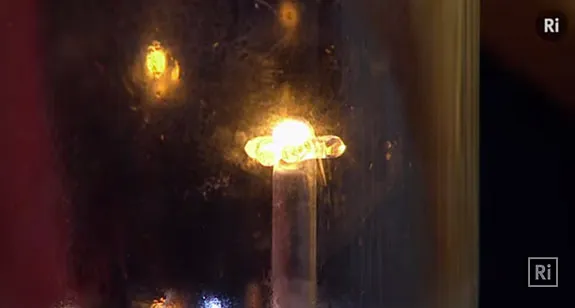
Surprisingly, that lit up, too. The diamond burned as a golden ember without producing any flames. At that point, Kroto half-jokingly commented that he hoped Wothers could afford to pay for a replacement diamond.
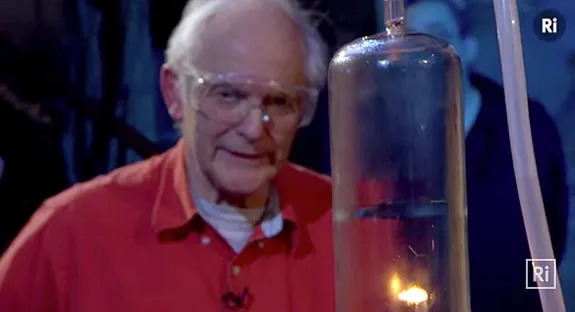
As you might have figured out by now, Wothers had cleverly swapped the Krotos’ engagement diamond with a much lower quality specimen before the experiment began.

If you’re worried about how a diamond is protected when a ring needs to be retipped, for example, be assured that jewelers go to great lengths to make sure that the extreme heat of the torch does not affect the gemstone. Some jewelers use boric acid to protect the stone while others depend on the pinpoint accuracy of a laser welder to keep the diamond out of harm’s way.

Kroto won his Nobel Prize in Chemistry in 1996 for his work in discovering fullerenes, a pure carbon molecule that takes a shape similar to a soccer ball. Research has suggested many uses for fullerenes, including medical applications, superconductors, fiber-optics systems and nanotechnology.

Check out Wothers’ diamond-burning experiment here…

Credits: Screen captures via YouTube.com.

Categories
A Century of Luxury & Legacy7
  • Previous Article
  • Next Article
Contact Us
Call Us 770.578.0598
Text Us 770.578.0598
Email Us Here

Visit Us
3605 Sandy Plains Road
Marietta, GA 30066

Tues-Fri: 10am - 6pm
Sat: 10am - 4pm
Sun: CLOSED
Mon: CLOSED

Quick Links
  • My Account
  • Returns
  • Our Services
  • Lifetime Warranty
  • Diamond Upgrade
  • Flexible Financing
  • David Douglas Rewards
Our Services
  • Jewelry Repair
  • Custom Jewelry
  • Sell Your Jewelry
  • Jewelry Appraisals
  • Ear Piercing
  • Permanent Jewelry
Shop Jewelry
  • All Jewelry
  • Rings
  • Earrings
  • Necklaces
  • Bracelets
  • Watches
About Us
  • Our Story
  • Responsible Sourcing
  • In Our Community
  • Our Designers
  • Client Stories
Follow Us
SITE MAP PRIVACY & SECURITY Lifetime Warranty RETURN POLICY

© 2026 David Douglas Diamonds & Jewelry. All Rights Reserved. Website designed, maintained, and hosted by Punchmark

  • Return Policy
  • Privacy Policy
  • Terms & Conditions
  • Accessibility Statement

© 2026 David Douglas Diamonds & Jewelry. All Rights Reserved.

Powered by: Punchmark

My Bag
Shopping cart contents
Loading

Learn how we use cookies in our Privacy Policy or manage cookie preferences.