
Skip to primary navigationSkip to main contentSkip to footer
  • (770) 578-0598
  • Visit Our Showroom
  • Contact Us
  • Toggle Toolbar Search Menu
  • Toggle My Account Menu
    Login
    Forgot Password?

    Don’t have an account? Sign up now

  • Toggle My Wish List
  • Toggle Search Menu
  • Toggle My Wishlist
  • Toggle Shopping Cart Menu
David Douglas Diamonds & Jewelry logo
  • Dave Douglas Jewelry Logo
  • Engagement
    Engagement Rings
    Customizable Engagement RingsSemi-Set Engagement Rings
    Pre-set Engagement Rings
    Diamond Engagement RingsLab Diamond Engagement RingsShop all Pre-Set Engagement Rings
    Shop By Style
    SolitaireClassicUnique HaloThree StoneVintage
    Shop By Shape
    RoundOvalEmeraldPearCushionMarquise
    Featured
    Hidden Halo Engagement RingsGabriel & Co
    Education
    Engagement Ring BenefitsJewelry FinancingLifetime WarrantyDesign Concierge
    Browse All Engagement
  • Wedding
    Women
    Classic BandsModern BandsAnniversary BandsCurved BandsLuxe Bands
    Men
    Classic BandsModern Metal BandsMixed Metal BandsPattern BandsStones & Inlays
    Men's By Metal
    PlatinumYellow GoldWhite GoldRose Gold
    Modern Metals
    Damascus SteelMeteoriteTantalumZirconium
    Designers
    Chris Ploof DesignsAmmara StoneHeavy Stone Rings
    Wedding Day Jewelry
    Diamond StudsDiamond PendantsTennis Bracelets
    Build Your Wedding Band
    Menu image
  • Diamonds
    Natural Diamonds
    RoundPrincessEmeraldAsscherRadiantCushionOvalPearMarquiseHeart
    Canadamark Diamonds
    Specialty Diamonds
    Lab-Grown Diamonds
    Search Lab Diamonds8x Lab DiamondsSustainably Rated Lab Diamonds
    Featured
    Salt & Pepper DiamondsPre-Set Engagement Rings
    Education
    Diamond FinancingLifetime Diamond UpgradeAbout Lab Grown Diamonds
    Shop Loose Diamonds
  • Custom
    DESIGN YOUR OWN
    Custom Design JewelryWhat to ExpectClient Stories
    CUSTOM JEWELRY
    Custom Design GalleryAward Winning DesignsOur DesignersOur Process
    ONE OF A KIND
    Handmade JewelryHand Engraved JewelryVisit Us In Marietta
    Menu image
  • Jewelry
    SEARCH JEWELRY
    RingsEarringsNecklacesBraceletsWatchesShop All Jewelry
    SHOP BY STYLE
    Diamond Stud EarringsCocktail RingsTennis BraceletsHoop EarringsMen’s JewelryEstate Jewelry
    SERVICES
    Jewelry RepairCustom JewelrySell Your JewelryAppraisalsEar PiercingView All Services
    FEATURED
    Gabriel & Co. FashionShinola WatchesHandmade JewelryreDesign Your RingDavid Douglas Rewards
    Menu image
  • About
    ABOUT US
    Our StoryResponsible SourcingIn Our CommunityAward Winning
    SERVICES
    Jewelry RepairCustom JewelrySell Your JewelryAppraisalsEar PiercingView All Services
    STAY CONNECTED
    Contact UsDavid Douglas Blog
    STAY SOCIAL
    InstagramFacebook
    QUICK LINKS
    Return PolicyEngagement Ring BenefitsLifetime WarrantyJewelry FinancingDavid Douglas Rewards
    Menu image
  • (770) 578-0598
  • Visit Our Showroom
  • Contact Us
  • Toggle Toolbar Search Menu
  • Toggle My Account Menu
    Login
    Forgot Password?

    Don’t have an account? Sign up now

  • Toggle My Wish List
David Douglas Diamonds & Jewelry logo
Log In
  1. Home
  2. Blog
  3. Here Are the Four 'Keh-Ruht' Homophones Every Jewelry Lover Should Know

Here Are the Four 'Keh-Ruht' Homophones Every Jewelry Lover Should Know

Published: Jul 22, 2026
Here Are the Four 'Keh-Ruht' Homophones Every Jewelry Lover Should Know
Author: 
Howard Cohen

Some lessons from elementary school have a funny way of resurfacing years later — especially when you're shopping for jewelry.
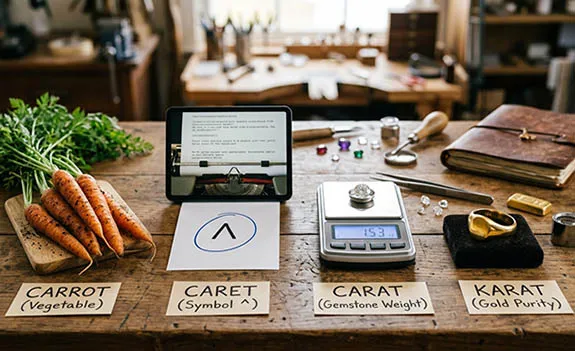
Remember learning about homophones? They're words that sound exactly alike but have entirely different spellings and meanings, such as sea and see or flour and flower. The jewelry world happens to have one of the English language's most entertaining examples: carat, karat, caret and carrot. All four are pronounced "keh-ruht," yet each means something completely different.

Let's see if you can keep them straight.

Carrot is the easiest place to start. It's the crunchy orange root vegetable famously favored by Bugs Bunny. Rich in beta carotene, fiber, potassium and antioxidants, carrots are equally at home in salads, soups and healthy snacks. Delicious? Absolutely. Related to jewelry? Not at all.

Caret may be the least familiar of the four. It's the little inverted V-shaped proofreading symbol (^) used by editors and writers to show where a missing letter, word or punctuation mark should be inserted into a sentence. Once you know its name, you'll never look at your keyboard the same way again.

Now we arrive at the two homophones that truly matter in the jewelry business.

Carat (with a "C") is the universal unit of weight for gemstones and pearls. One carat equals exactly 200 milligrams, or one-fifth of a gram, and each carat is divided into 100 points. That's why jewelers often describe a quarter-carat diamond as a "25-pointer." A center diamond weighing 1.50 carats, meanwhile, would simply be described as a 1.50-carat stone.

The word traces its roots to the Italian "carato," derived from the Greek word for the carob seed, which ancient merchants used as a surprisingly consistent reference for weighing small objects. The modern international standard of 200 milligrams per carat was officially adopted in 1907, replacing a patchwork of regional measurements that often varied considerably.

Karat (with a "K") has nothing to do with weight. Instead, it measures the purity of gold on a 24-part scale. Pure gold is 24-karat, while 18-karat gold contains 18 parts gold and six parts alloy metals, making it 75% pure. Fourteen-karat gold is 58.3% pure and remains one of the most popular choices for fine jewelry because it offers an excellent balance of beauty, durability and value. Jewelers blend gold with metals such as silver, copper, zinc and nickel to increase strength and even create colors such as rose or white gold.

Interestingly, while the US, Canada, Mexico and some Asian markets distinguish between carat and karat, in the United Kingdom, Australia, New Zealand, Ireland and other British-influenced regions, carat is used for both gemstone weight and gold purity. In those areas, context — and abbreviations such as ct for gemstone weight and 18ct for gold — makes the meaning clear.

Meanwhile, many continental European countries avoid the confusion altogether by using the millésimal fineness system, stamping jewelry with three-digit numbers instead of words. An 18-karat gold ring, for example, is commonly marked 750, indicating that it is 750 parts per thousand — or 75% — pure gold.

So the next time someone mentions a "keh-ruht," you'll know whether they're talking about a diamond, a gold alloy, a proofreading mark... or something best served with ranch dressing.

Credit: Image by The Jeweler Blog using aichatapp.ai.

Categories
A Century of Luxury & Legacy26
  • Previous Article
  • Next Article
Contact Us
Call Us 770.578.0598
Text Us 770.578.0598
Email Us Here

Visit Us
3605 Sandy Plains Road
Marietta, GA 30066

Tues-Fri: 10am - 6pm
Sat: 10am - 4pm
Sun: CLOSED
Mon: CLOSED

Quick Links
  • My Account
  • Returns
  • Our Services
  • Lifetime Warranty
  • Diamond Upgrade
  • Flexible Financing
  • David Douglas Rewards
Our Services
  • Jewelry Repair
  • Custom Jewelry
  • Sell Your Jewelry
  • Jewelry Appraisals
  • Ear Piercing
  • Permanent Jewelry
Shop Jewelry
  • All Jewelry
  • Rings
  • Earrings
  • Necklaces
  • Bracelets
  • Watches
About Us
  • Our Story
  • Responsible Sourcing
  • In Our Community
  • Our Designers
  • Client Stories
Follow Us
SITE MAP PRIVACY & SECURITY Lifetime Warranty RETURN POLICY

© 2026 David Douglas Diamonds & Jewelry. All Rights Reserved. Website designed, maintained, and hosted by Punchmark

  • Return Policy
  • Privacy Policy
  • Terms & Conditions
  • Accessibility Statement

© 2026 David Douglas Diamonds & Jewelry. All Rights Reserved.

Powered by: Punchmark

My Cart
You have 0 items in your Cart.
Loading cart items
Loading

Learn how we use cookies in our Privacy Policy or manage cookie preferences.