
Skip to main contentSkip to footer
  • (770) 578-0598
  • Visit Our Showroom
  • Contact Us
  • Toggle Toolbar Search Menu
  • Toggle My Account Menu
    Login
    Forgot Password?

    Don’t have an account? Sign up now

  • Toggle My Wish List
  • Toggle Search Menu
  • Toggle My Wishlist
  • Toggle Shopping Cart Menu
testing meta info
  • Engagement
    Engagement Rings
    Customizable Engagement RingsSemi-Set Engagement Rings
    Pre-set Engagement Rings
    Diamond Engagement RingsLab Diamond Engagement RingsShop all Pre-Set Engagement Rings
    Shop By Style
    SolitaireClassicUnique HaloThree StoneVintage
    Shop By Shape
    RoundOvalEmeraldPearCushionMarquise
    Featured
    Hidden Halo Engagement RingsGabriel & Co
    Education
    Engagement Ring BenefitsJewelry FinancingLifetime WarrantyDesign Concierge
    Browse All Engagement
  • Wedding
    Women
    Classic BandsModern BandsAnniversary BandsCurved BandsLuxe Bands
    Men
    Classic BandsModern Metal BandsMixed Metal BandsPattern BandsStones & Inlays
    Men's By Metal
    PlatinumYellow GoldWhite GoldRose Gold
    Modern Metals
    Damascus SteelMeteoriteTantalumZirconium
    Designers
    Chris Ploof DesignsAmmara StoneHeavy Stone Rings
    Wedding Day Jewelry
    Diamond StudsDiamond PendantsTennis Bracelets
    Build Your Wedding Band
    Menu image
  • Diamonds
    Natural Diamonds
    RoundPrincessEmeraldAsscherRadiantCushionOvalPearMarquiseHeart
    Canadamark Diamonds
    Specialty Diamonds
    Lab-Grown Diamonds
    Search Lab Diamonds8x Lab DiamondsSustainably Rated Lab Diamonds
    Featured
    Salt & Pepper DiamondsPre-Set Engagement Rings
    Education
    Diamond FinancingLifetime Diamond UpgradeAbout Lab Grown Diamonds
    Shop Loose Diamonds
  • Custom
    DESIGN YOUR OWN
    Custom Design JewelryWhat to ExpectClient Stories
    CUSTOM JEWELRY
    Custom Design GalleryAward Winning DesignsOur DesignersOur Process
    ONE OF A KIND
    Handmade JewelryHand Engraved JewelryVisit Us In Marietta
    Menu image
  • Jewelry
    SEARCH JEWELRY
    RingsEarringsNecklacesBraceletsWatchesShop All Jewelry
    SHOP BY STYLE
    Diamond Stud EarringsCocktail RingsTennis BraceletsHoop EarringsMen’s JewelryEstate Jewelry
    SERVICES
    Jewelry RepairCustom JewelrySell Your JewelryAppraisalsEar PiercingView All Services
    FEATURED
    Gabriel & Co. FashionShinola WatchesHandmade JewelryreDesign Your RingDavid Douglas Rewards
    Menu image
  • About
    ABOUT US
    Our StoryResponsible SourcingIn Our CommunityAward Winning
    SERVICES
    Jewelry RepairCustom JewelrySell Your JewelryAppraisalsEar PiercingView All Services
    STAY CONNECTED
    Contact UsDavid Douglas Blog
    STAY SOCIAL
    InstagramFacebook
    QUICK LINKS
    Return PolicyEngagement Ring BenefitsLifetime WarrantyJewelry FinancingDavid Douglas Rewards
    Menu image
  • (770) 578-0598
  • Visit Our Showroom
  • Contact Us
  • Toggle Toolbar Search Menu
  • Toggle My Account Menu
    Login
    Forgot Password?

    Don’t have an account? Sign up now

  • Toggle My Wish List
testing meta info
Log In My Cart
  1. Home
  2. Blog
  3. Find Out How the Hope Pearl and Hope Diamond Reunited After 156 Years Apart

Find Out How the Hope Pearl and Hope Diamond Reunited After 156 Years Apart

Published: Jun 1, 2023
Find Out How the Hope Pearl and Hope Diamond Reunited After 156 Years Apart
Author: 
Howard Cohen

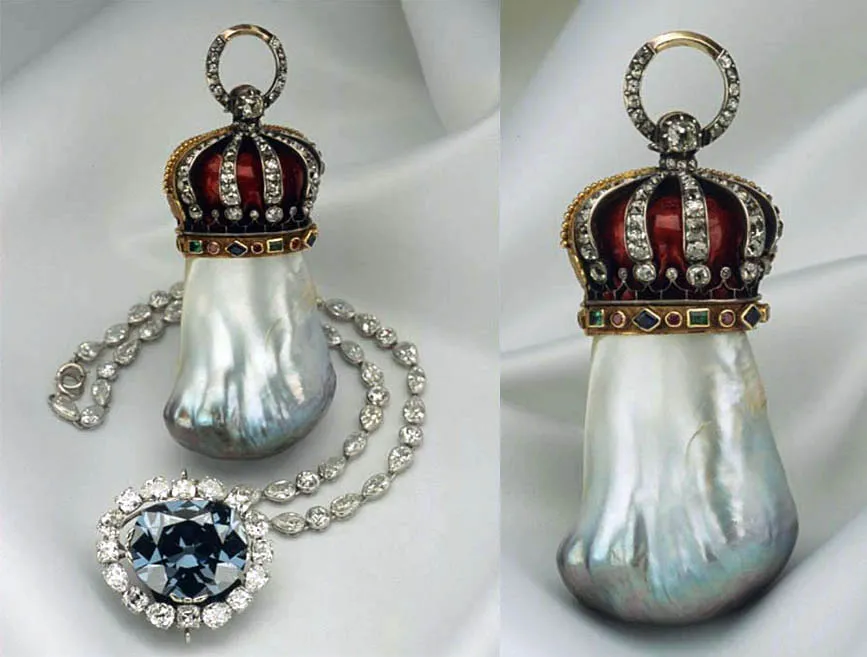
Let’s celebrate June’s official birthstone with a deep dive into the backstory of one of the most celebrated natural pearls in the world — the Hope Pearl — and its famous sibling, the Hope Diamond.
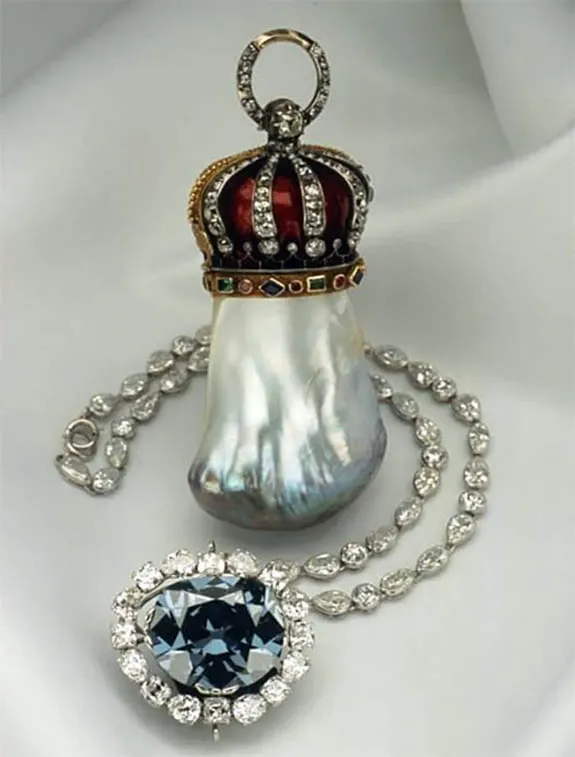
How these two museum-quality pieces were reunited after 156 years apart is a heartwarming and intriguing tale. Read on…

Back in the early part of the 19th century, a London banker named Henry Philip Hope amassed a collection of fabulous gems, including the deep blue 45.52-carat Hope Diamond and 150 extraordinarily rare natural pearls.
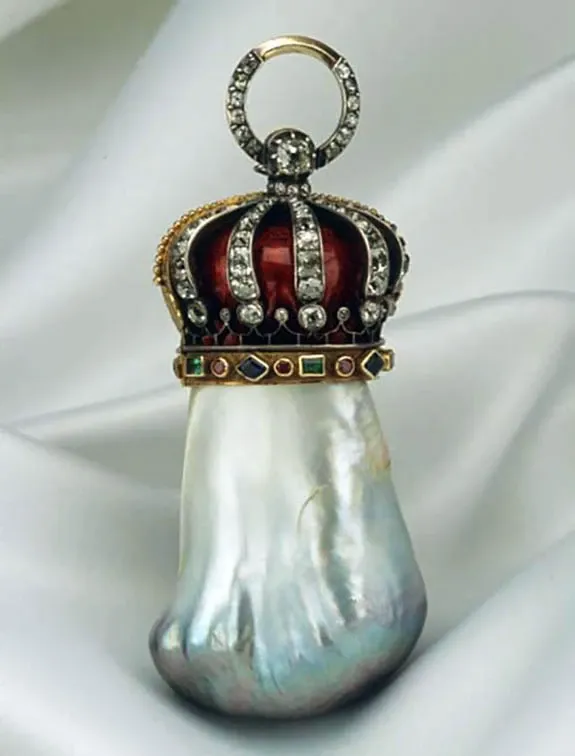
Hope’s namesake pearl, which was once believed to be the largest natural saltwater baroque pearl in existence, is set as a pendant, with the narrower end capped with a crown of red enameled gold set with diamonds, rubies and emeralds. The pearl stands two inches tall and weighs 450 carats.

It exhibits an irregular pear shape and a unique coloration, grading from dark bronze to white. Experts believe the baroque specimen is a blister pearl, which grows attached to the mollusk’s shell.

Both the Hope Diamond (purchased in 1824) and Hope Pearl (purchased between 1800 and 1810) were mentioned prominently in the 1839 publication titled “Catalogue of the Collection of Pearls and Precious Stones Formed by Henry Philip Hope, Esq.”

Hope, who never married, died that same year at the age of 65.

A bitter legal battle ensued among his three nephews. Each of them made claims on the estate, and after 10 years, a settlement was reached and the jewels were split up. The pearl ended up in the South Kensington Museum for many years, and was sold at a Christie’s auction in 1886 for £9,000 (about £950,000, or $1.18 million, in today’s valuation).

The Hope Diamond and Hope Pearl remained apart for the next 156 years. But then, in 2005, the diamond and pearl siblings enjoyed a momentous six-month reunion at the Smithsonian in Washington, DC. The Hope Diamond was already a resident of the National Gem and Mineral collection at the National Museum of Natural History.

The Hope Pearl was one of 12 extraordinary specimens featured in a special exhibition called “The Allure of Pearls” in the Harry Winston Gallery of the Janet Annenberg Hooker Hall of Geology, Gems and Minerals. The Hope Pearl was loaned for the presentation by an unnamed collector from England.

Other specimens in the exhibition included La Peregrina, the Pearl of Asia, the Drexel Pearl, the Black Beauty, the Pearl of Kuwait, the Queen Mary Brooch with two large natural pink conch pearls, the South Sea Drops, the Survival Pearl and the Paspaley Pearl.

A natural pearl is extraordinarily rare and valuable because it is formed inside a mollusk totally by chance, without human intervention. A natural pearl forms when an irritant, such as a grain of sand, slips between the mollusk’s shell and its mantle tissue.

To protect itself from the irritant, the mollusk secretes layer upon layer of nacre, which is the iridescent material that eventually produces a pearl. Cultured pearls, by comparison, are grown under controlled conditions, where a bead is implanted in the body of the mollusk to stimulate the secretion of nacre.

Pearl is one of the three official birthstones for June. The others are alexandrite and moonstone.

Credits: Smithsonian/NMNH Photo Services.

Categories
Doug's Cool ThingsDavid Douglas Diamonds3
  • Previous Article
  • Next Article
Contact Us
Call Us 770.578.0598
Text Us 770.578.0598
Email Us Here

Visit Us
3605 Sandy Plains Road
Marietta, GA 30066

Tues-Fri: 10am - 6pm
Sat: 10am - 4pm
Sun: CLOSED
Mon: CLOSED

Quick Links
  • My Account
  • Returns
  • Our Services
  • Lifetime Warranty
  • Diamond Upgrade
  • Flexible Financing
  • David Douglas Rewards
Our Services
  • Jewelry Repair
  • Custom Jewelry
  • Sell Your Jewelry
  • Jewelry Appraisals
  • Ear Piercing
  • Permanent Jewelry
Shop Jewelry
  • All Jewelry
  • Rings
  • Earrings
  • Necklaces
  • Bracelets
  • Watches
About Us
  • Our Story
  • Responsible Sourcing
  • In Our Community
  • Our Designers
  • Client Stories
Follow Us
SITE MAP PRIVACY & SECURITY Lifetime Warranty RETURN POLICY

© 2025 David Douglas Diamonds & Jewelry. All Rights Reserved. Website designed, maintained, and hosted by Punchmark

  • Return Policy
  • Privacy Policy
  • Terms & Conditions
  • Accessibility Statement

© 2026 David Douglas Diamonds & Jewelry. All Rights Reserved.

Powered by: Punchmark

My Bag
Shopping cart contents
Loading

Learn how we use cookies in our Privacy Policy or manage cookie preferences.