
Skip to main contentSkip to footer
  • (770) 578-0598
  • Visit Our Showroom
  • Contact Us
  • Toggle Toolbar Search Menu
  • Toggle My Account Menu
    Login
    Forgot Password?

    Don’t have an account? Sign up now

  • Toggle My Wish List
  • Toggle Search Menu
  • Toggle My Wishlist
  • Toggle Shopping Cart Menu
testing meta info
  • Engagement
    Engagement Rings
    Customizable Engagement RingsSemi-Set Engagement Rings
    Pre-set Engagement Rings
    Diamond Engagement RingsLab Diamond Engagement RingsShop all Pre-Set Engagement Rings
    Shop By Style
    SolitaireClassicUnique HaloThree StoneVintage
    Shop By Shape
    RoundOvalEmeraldPearCushionMarquise
    Featured
    Hidden Halo Engagement RingsGabriel & Co
    Education
    Engagement Ring BenefitsJewelry FinancingLifetime WarrantyDesign Concierge
    Browse All Engagement
  • Wedding
    Women
    Classic BandsModern BandsAnniversary BandsCurved BandsLuxe Bands
    Men
    Classic BandsModern Metal BandsMixed Metal BandsPattern BandsStones & Inlays
    Men's By Metal
    PlatinumYellow GoldWhite GoldRose Gold
    Modern Metals
    Damascus SteelMeteoriteTantalumZirconium
    Designers
    Chris Ploof DesignsAmmara StoneHeavy Stone Rings
    Wedding Day Jewelry
    Diamond StudsDiamond PendantsTennis Bracelets
    Build Your Wedding Band
    Menu image
  • Diamonds
    Natural Diamonds
    RoundPrincessEmeraldAsscherRadiantCushionOvalPearMarquiseHeart
    Canadamark Diamonds
    Specialty Diamonds
    Lab-Grown Diamonds
    Search Lab Diamonds8x Lab DiamondsSustainably Rated Lab Diamonds
    Featured
    Salt & Pepper DiamondsPre-Set Engagement Rings
    Education
    Diamond FinancingLifetime Diamond UpgradeAbout Lab Grown Diamonds
    Shop Loose Diamonds
  • Custom
    DESIGN YOUR OWN
    Custom Design JewelryWhat to ExpectClient Stories
    CUSTOM JEWELRY
    Custom Design GalleryAward Winning DesignsOur DesignersOur Process
    ONE OF A KIND
    Handmade JewelryHand Engraved JewelryVisit Us In Marietta
    Menu image
  • Jewelry
    SEARCH JEWELRY
    RingsEarringsNecklacesBraceletsWatchesShop All Jewelry
    SHOP BY STYLE
    Diamond Stud EarringsCocktail RingsTennis BraceletsHoop EarringsMen’s JewelryEstate Jewelry
    SERVICES
    Jewelry RepairCustom JewelrySell Your JewelryAppraisalsEar PiercingView All Services
    FEATURED
    Gabriel & Co. FashionShinola WatchesHandmade JewelryreDesign Your RingDavid Douglas Rewards
    Menu image
  • About
    ABOUT US
    Our StoryResponsible SourcingIn Our CommunityAward Winning
    SERVICES
    Jewelry RepairCustom JewelrySell Your JewelryAppraisalsEar PiercingView All Services
    STAY CONNECTED
    Contact UsDavid Douglas Blog
    STAY SOCIAL
    InstagramFacebook
    QUICK LINKS
    Return PolicyEngagement Ring BenefitsLifetime WarrantyJewelry FinancingDavid Douglas Rewards
    Menu image
  • (770) 578-0598
  • Visit Our Showroom
  • Contact Us
  • Toggle Toolbar Search Menu
  • Toggle My Account Menu
    Login
    Forgot Password?

    Don’t have an account? Sign up now

  • Toggle My Wish List
testing meta info
Log In My Cart
  1. Home
  2. Blog
  3. Famous for His Stained Glass, Louis Tiffany Designed This Opal Necklace in 1929

Famous for His Stained Glass, Louis Tiffany Designed This Opal Necklace in 1929

Published: Oct 11, 2022
Famous for His Stained Glass, Louis Tiffany Designed This Opal Necklace in 1929
Author: 
Howard Cohen

The finest black opals come from Lightning Ridge, an Aussie mining area that has been yielding top-quality opals since 1903 — about the same time Louis Comfort Tiffany took his first stab at designing fine jewelry at the age of 54.
Tiffany, whose father was Charles Lewis Tiffany, the founder of the famous jewelry company, was already a household name based on his magnificent stained glass, ceramics and metalwork. When the elder Tiffany passed away in 1902, his son was determined to embrace a new discipline.

According to the The Metropolitan Museum of Art, Louis Tiffany's earliest jewelry designs were exhibited at the 1904 Louisiana Purchase Exposition in St. Louis, where they earned favorable reviews from the art critics of the period. Tiffany's naturalistic designs, use of semiprecious stones with enamel and meticulous handcraftsmanship elevated his imaginative jewelry to the status of art.
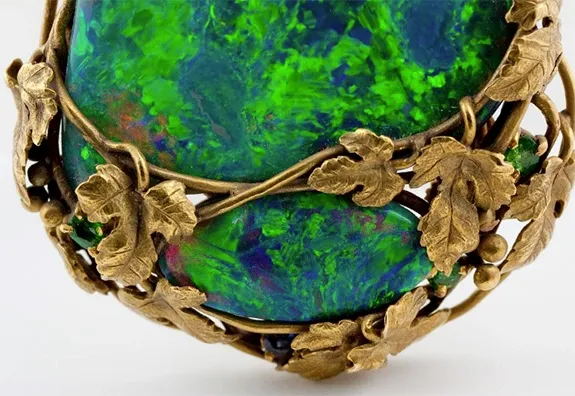
Tiffany was particularly fond of opals, according to the Smithsonian, and used them extensively in his work. Louis often sought the advice and expertise of George Frederick Kunz, the gem expert at Tiffany & Company, who traveled the world in search of unusual gems and semi-precious stones for the company’s designers.

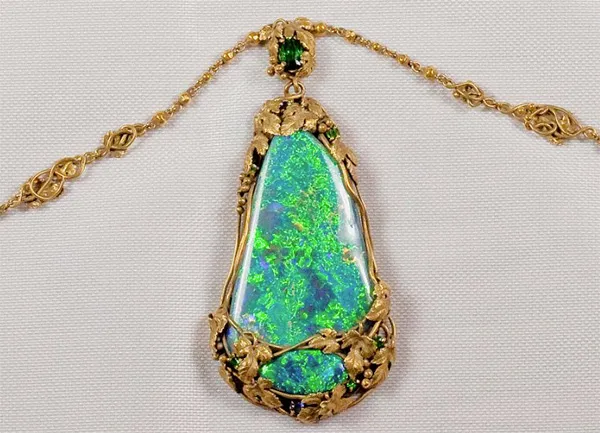
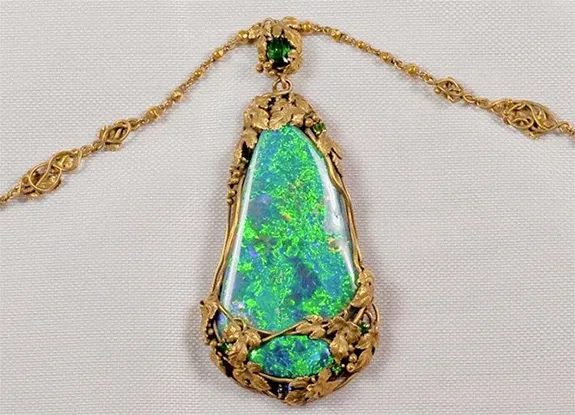
Louis designed the black opal necklace, shown above, later in his career. The Art Nouveau necklace is 30-inches in length and features two black opals — a large one on top and a smaller one at the bottom — secured in a vine of 18-karat gold grape leaves and accented with brilliant-cut green demantoid garnets.

Donated to the Smithsonian in 1974 by Mrs. F. R. Downs Jr. and Mrs. R. O. Abbott Jr., the unique piece was originally purchased from Tiffany's on New Year's Eve 1929, according to the original sales receipt. It is currently part of the National Gem Collection at the National Museum of Natural History in Washington, DC, and an excellent example of October's official birthstone. The other October birthstone is tourmaline.

Precious opals are universally loved because they can present all the colors of the rainbow. Each opal is truly unique and more than 95% of the world’s fine opals are sourced in Australia. Other varieties include white opals, boulder opals, crystal opals and fire opals.

Scientists believe that between 100 million and 97 million years ago, Australia’s vast inland sea, which was populated by marine dinosaurs, began retreating. As the sea regressed, a rare episode of acidic weather was taking place, exposing pyrite minerals and releasing sulphuric acid. As the surface of the basin dried further and cracked, silica-rich gel became trapped in the veins of the rock. Over time, the silica solidified to form opals.

In precious opal, the silica spheres are uniform in size and are stacked into an orderly arrangement, which gives the structure the ability to break visible white light into separate colors.

Interestingly, 95% of the opals found by miners is void of color. These specimens are white, grey or black. The locals call it “potch” and it has very little value. Potch is composed of the exact same mineral as fine opal – spheres of silica dioxide. The only difference is that in potch, the tiny silica spheres are jumbled, whereas in precious opal they’re all laid out evenly.

The value of a fine opal is based on a number of factors, including brightness, color, pattern, body tone and consistency (how it looks from multiple angles).

Credits: Images by Ken Larsen / Smithsonian.

Categories
Doug's Cool ThingsDavid Douglas Diamonds3
  • Previous Article
  • Next Article
Contact Us
Call Us 770.578.0598
Text Us 770.578.0598
Email Us Here

Visit Us
3605 Sandy Plains Road
Marietta, GA 30066

Tues-Fri: 10am - 6pm
Sat: 10am - 4pm
Sun: CLOSED
Mon: CLOSED

Quick Links
  • My Account
  • Returns
  • Our Services
  • Lifetime Warranty
  • Diamond Upgrade
  • Flexible Financing
  • David Douglas Rewards
Our Services
  • Jewelry Repair
  • Custom Jewelry
  • Sell Your Jewelry
  • Jewelry Appraisals
  • Ear Piercing
  • Permanent Jewelry
Shop Jewelry
  • All Jewelry
  • Rings
  • Earrings
  • Necklaces
  • Bracelets
  • Watches
About Us
  • Our Story
  • Responsible Sourcing
  • In Our Community
  • Our Designers
  • Client Stories
Follow Us
SITE MAP PRIVACY & SECURITY Lifetime Warranty RETURN POLICY

© 2025 David Douglas Diamonds & Jewelry. All Rights Reserved. Website designed, maintained, and hosted by Punchmark

  • Return Policy
  • Privacy Policy
  • Terms & Conditions
  • Accessibility Statement

© 2026 David Douglas Diamonds & Jewelry. All Rights Reserved.

Powered by: Punchmark

My Bag
Shopping cart contents
Loading

Learn how we use cookies in our Privacy Policy or manage cookie preferences.