
A Century of Luxury & Legacy
Building a Team: Lessons From a Family Jewelry Business
Published: Aug 9, 2026
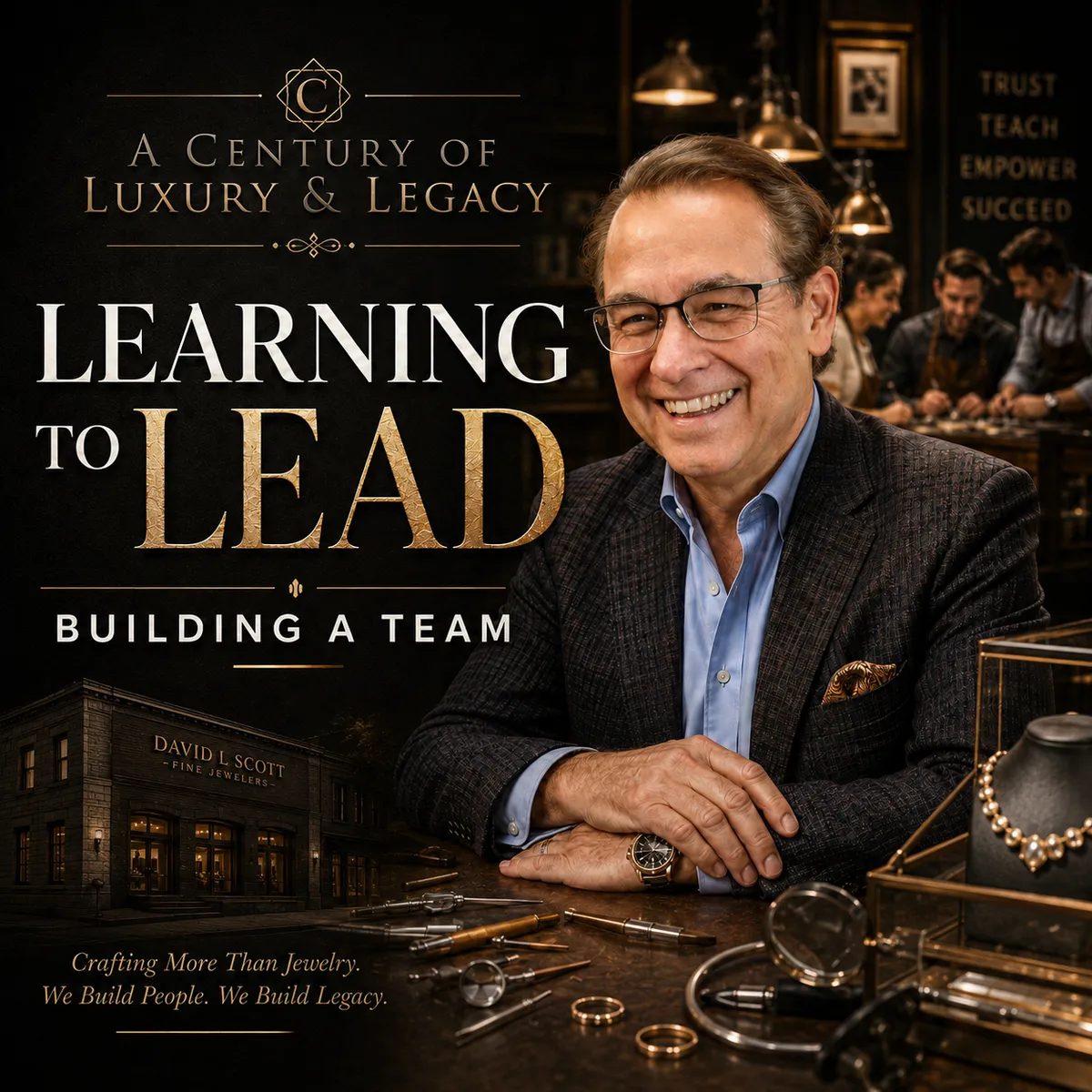
What My Employees Taught Me About Leadership
When I look back over 100 years of our family in the jewelry business, I’m reminded that the story isn’t only about jewelry.
It’s about people.
Last week, I started talking about employees, staffing, and what it means to build a team. The more I thought about it, the more I realized just how much of my own education in business came from the people who worked alongside me.
And much of that education came through making mistakes.
When the Workforce Was Family
I don’t know a lot about how my grandfather handled employees in his business. By the time I came along and began working with my dad and uncle, most of the labor I saw was family.
It was me, my brothers, my cousins, my dad, and my uncle.
There were a few people outside the family who came through the shop. One was John McMartin. His family owned McMartin’s Jewelers in Milford, Michigan, and his father was a watchmaker. When John was coming up in the business, his family asked my dad and uncle if they would apprentice him as a jeweler.
That happened mostly before my time, but looking back, I think there was something special about that old apprenticeship model.
You didn’t just hire somebody.
You taught them a trade.
Starting Over in Atlanta
Eventually, I left my dad’s shop and worked with my brother Danny. That’s where I met my friend Merl Maddox.
Merl was a bench jeweler, and because of that skill, he could pretty much find work wherever he wanted. He eventually decided he was tired of Michigan and moved to Atlanta.
That move would change my life, too.
Merl invited me down to see Atlanta, and I fell in love with it. Before long, we began talking about going into business together.
So in April of 1982, as best as I remember, I packed up and moved from Michigan to Atlanta.
The plan sounded pretty good.
Merl would run a leased jewelry department inside Pure Gold Jewelers at Cumberland Mall, and I would begin developing a trade shop serving other jewelers around Atlanta.
Of course, plans have a funny way of changing.
Not long after I arrived, the space we were using for our trade shop was no longer available. Then Pure Gold Jewelers went up for sale.
That was our bread and butter.
So, like a lot of young entrepreneurs who probably didn’t know enough to be scared, we begged, borrowed, and scraped together whatever we could from friends and family.
And we bought the jewelry store.
We had absolutely no clue what we were doing.
Learning Business the Hard Way
We kept the trade business going, doing work for companies like Sears, Macy’s, and other jewelry stores.
My wife even became our delivery service. A couple of days a week she would drive around Atlanta picking up and dropping off repair work.
There was a lot of work.
There wasn’t always a lot of reward.
But there was plenty of education.
Eventually my brother Dave came down from Michigan, and together we created our first David Douglas Diamonds store.
It was basically the two of us.
We worked a lot of hours.
Then Kaminski Jewelers approached us about operating a leased department inside their store. Dave spent most of his days there while I ran David Douglas Diamonds about a mile or so away.
That created another problem we hadn’t anticipated.
Communication.
Dave was overwhelmed at Kaminski’s. He could take in work all day, but he barely had time to actually complete it. In the evenings he would come back over to our store, and together we would sit at the benches and knock out the repair work.
We were growing.
And for the first time, it became obvious that Dave and I couldn’t do everything ourselves.
We needed employees.
My First Lesson in Hiring
I hired a young man from my church named Randall.
I thought I was solving a problem.
Instead, I created another one.
Dave was already drowning at Kaminski’s, and here I was hiring someone to help me.
Needless to say, my brother wasn’t particularly happy with me.
Eventually I sent Randall over to help Dave. We apprenticed him as a bench jeweler, and he began learning things like chain soldering, ring sizing, and repair work.
Then I hired another young man from church named David and started teaching him.
We hired a bookkeeper because neither Dave nor I was particularly gifted in that department.
Little by little, we were building a team.
And little by little, I was discovering that hiring people was the easy part.
Leading them was something completely different.
People Don’t Learn Through Osmosis
As the business grew, so did the number of employees.
At Kaminski’s, we eventually had six or seven bench jewelers, along with several people working at the counter. We had high school students and part-time employees helping us cover the long retail hours.
Suddenly I had to learn about scheduling.
Raises.
Training.
Performance.
Accountability.
How much is somebody worth?
When should they get a raise?
What happens when somebody isn’t performing the way you expected?
I didn’t have a manual for any of this.
And trust me, we made mistakes.
I remember one employee who just didn’t seem to fit the way we expected. We struggled with it and eventually let her go.
Her father called afterward, and he was very upset with the way we had handled it.
That experience stuck with me.
It forced me to ask a question I hadn’t really considered before:
When an employee isn’t succeeding, whose fault is it?
Over the years, I came to believe that I have to start by looking at myself.
Did I clearly explain what was expected?
Did I train them properly?
Did I follow up?
Did I hold them accountable?
Did I give them what they needed to succeed?
Too often, we hire somebody and expect them to figure everything out.
We think they’ll learn through observation.
Or osmosis.
“They should know what to do.”
But why should they?
Every person comes from a different background. We have different experiences, different work ethics, different expectations, and different ideas about what doing a good job even looks like.
Leadership requires clarity.
Creating Better Training
Eventually, I started becoming much more intentional about training.
I had several young women working for me who were studying to become teachers. One of them helped create my first website.
Two others helped me develop an employee training manual.
That manual became incredibly valuable.
We broke the employee’s first ten days into specific lessons. There were examples, scenarios, exercises, and tests.
Instead of simply saying, “Here’s the store. Good luck,” we began creating a process.
And much of that training material is still useful today.
That says something to me.
Systems matter.
Training matters.
But more than anything, people matter.
The Christmas Notes
One tradition came from my brother Dave’s wife.
She suggested that at Christmas we should write a handwritten note to every employee and include their bonus inside.
We started doing it.
And I’ve never stopped.
It takes me a few days every year.
I don’t want to write the same generic message to everybody. I try to think about each individual person.
What did they contribute this year?
Where did they grow?
What did they do that made our company better?
What do I appreciate about them?
Then I write it down.
Over the years, employees have told me they kept those notes.
Some have saved them for years.
That blows me away.
And it humbles me.
Because sometimes a few sincere handwritten sentences can mean far more than we realize.
The Business Behind the Jewelry
Looking back, the Kaminski years were an incredible education.
We were there for roughly 17 years, if my memory is correct, and during that time I watched not only our own team grow but also saw the challenges that came with managing a much larger organization.
There were wonderful employees.
There were difficult situations.
There were even situations involving theft and financial dishonesty.
All of it became part of the education.
I began seeking out information about management, training, employee manuals, and leadership.
Because somewhere along the way I realized something:
A jewelry business may sell diamonds and gold, but the business itself is built by people.
And if you want the business to grow, you have to help the people grow.
I’m still learning that lesson.
I imagine I always will be.
Over these 100 years, our family business has changed tremendously. The stores have changed. Technology has changed. The jewelry industry has changed.
But people still want to know that their work matters.
They want clear expectations.
They want to grow.
They want to be appreciated.
And sometimes they just need somebody to take the time to tell them, sincerely, “Thank you. You made a difference here.”
That may be one of the most important leadership lessons this jewelry business has ever taught me.
And there’s still more to this story.
Next week, I’ll continue through the different generations of David Douglas Diamonds and share more about how our team—and my understanding of leadership—continued to grow.
Until then, thank you for being part of A Century of Luxury & Legacy.
When I look back over 100 years of our family in the jewelry business, I’m reminded that the story isn’t only about jewelry.
It’s about people.
Last week, I started talking about employees, staffing, and what it means to build a team. The more I thought about it, the more I realized just how much of my own education in business came from the people who worked alongside me.
And much of that education came through making mistakes.
When the Workforce Was Family
I don’t know a lot about how my grandfather handled employees in his business. By the time I came along and began working with my dad and uncle, most of the labor I saw was family.
It was me, my brothers, my cousins, my dad, and my uncle.
There were a few people outside the family who came through the shop. One was John McMartin. His family owned McMartin’s Jewelers in Milford, Michigan, and his father was a watchmaker. When John was coming up in the business, his family asked my dad and uncle if they would apprentice him as a jeweler.
That happened mostly before my time, but looking back, I think there was something special about that old apprenticeship model.
You didn’t just hire somebody.
You taught them a trade.
Starting Over in Atlanta
Eventually, I left my dad’s shop and worked with my brother Danny. That’s where I met my friend Merl Maddox.
Merl was a bench jeweler, and because of that skill, he could pretty much find work wherever he wanted. He eventually decided he was tired of Michigan and moved to Atlanta.
That move would change my life, too.
Merl invited me down to see Atlanta, and I fell in love with it. Before long, we began talking about going into business together.
So in April of 1982, as best as I remember, I packed up and moved from Michigan to Atlanta.
The plan sounded pretty good.
Merl would run a leased jewelry department inside Pure Gold Jewelers at Cumberland Mall, and I would begin developing a trade shop serving other jewelers around Atlanta.
Of course, plans have a funny way of changing.
Not long after I arrived, the space we were using for our trade shop was no longer available. Then Pure Gold Jewelers went up for sale.
That was our bread and butter.
So, like a lot of young entrepreneurs who probably didn’t know enough to be scared, we begged, borrowed, and scraped together whatever we could from friends and family.
And we bought the jewelry store.
We had absolutely no clue what we were doing.
Learning Business the Hard Way
We kept the trade business going, doing work for companies like Sears, Macy’s, and other jewelry stores.
My wife even became our delivery service. A couple of days a week she would drive around Atlanta picking up and dropping off repair work.
There was a lot of work.
There wasn’t always a lot of reward.
But there was plenty of education.
Eventually my brother Dave came down from Michigan, and together we created our first David Douglas Diamonds store.
It was basically the two of us.
We worked a lot of hours.
Then Kaminski Jewelers approached us about operating a leased department inside their store. Dave spent most of his days there while I ran David Douglas Diamonds about a mile or so away.
That created another problem we hadn’t anticipated.
Communication.
Dave was overwhelmed at Kaminski’s. He could take in work all day, but he barely had time to actually complete it. In the evenings he would come back over to our store, and together we would sit at the benches and knock out the repair work.
We were growing.
And for the first time, it became obvious that Dave and I couldn’t do everything ourselves.
We needed employees.
My First Lesson in Hiring
I hired a young man from my church named Randall.
I thought I was solving a problem.
Instead, I created another one.
Dave was already drowning at Kaminski’s, and here I was hiring someone to help me.
Needless to say, my brother wasn’t particularly happy with me.
Eventually I sent Randall over to help Dave. We apprenticed him as a bench jeweler, and he began learning things like chain soldering, ring sizing, and repair work.
Then I hired another young man from church named David and started teaching him.
We hired a bookkeeper because neither Dave nor I was particularly gifted in that department.
Little by little, we were building a team.
And little by little, I was discovering that hiring people was the easy part.
Leading them was something completely different.
People Don’t Learn Through Osmosis
As the business grew, so did the number of employees.
At Kaminski’s, we eventually had six or seven bench jewelers, along with several people working at the counter. We had high school students and part-time employees helping us cover the long retail hours.
Suddenly I had to learn about scheduling.
Raises.
Training.
Performance.
Accountability.
How much is somebody worth?
When should they get a raise?
What happens when somebody isn’t performing the way you expected?
I didn’t have a manual for any of this.
And trust me, we made mistakes.
I remember one employee who just didn’t seem to fit the way we expected. We struggled with it and eventually let her go.
Her father called afterward, and he was very upset with the way we had handled it.
That experience stuck with me.
It forced me to ask a question I hadn’t really considered before:
When an employee isn’t succeeding, whose fault is it?
Over the years, I came to believe that I have to start by looking at myself.
Did I clearly explain what was expected?
Did I train them properly?
Did I follow up?
Did I hold them accountable?
Did I give them what they needed to succeed?
Too often, we hire somebody and expect them to figure everything out.
We think they’ll learn through observation.
Or osmosis.
“They should know what to do.”
But why should they?
Every person comes from a different background. We have different experiences, different work ethics, different expectations, and different ideas about what doing a good job even looks like.
Leadership requires clarity.
Creating Better Training
Eventually, I started becoming much more intentional about training.
I had several young women working for me who were studying to become teachers. One of them helped create my first website.
Two others helped me develop an employee training manual.
That manual became incredibly valuable.
We broke the employee’s first ten days into specific lessons. There were examples, scenarios, exercises, and tests.
Instead of simply saying, “Here’s the store. Good luck,” we began creating a process.
And much of that training material is still useful today.
That says something to me.
Systems matter.
Training matters.
But more than anything, people matter.
The Christmas Notes
One tradition came from my brother Dave’s wife.
She suggested that at Christmas we should write a handwritten note to every employee and include their bonus inside.
We started doing it.
And I’ve never stopped.
It takes me a few days every year.
I don’t want to write the same generic message to everybody. I try to think about each individual person.
What did they contribute this year?
Where did they grow?
What did they do that made our company better?
What do I appreciate about them?
Then I write it down.
Over the years, employees have told me they kept those notes.
Some have saved them for years.
That blows me away.
And it humbles me.
Because sometimes a few sincere handwritten sentences can mean far more than we realize.
The Business Behind the Jewelry
Looking back, the Kaminski years were an incredible education.
We were there for roughly 17 years, if my memory is correct, and during that time I watched not only our own team grow but also saw the challenges that came with managing a much larger organization.
There were wonderful employees.
There were difficult situations.
There were even situations involving theft and financial dishonesty.
All of it became part of the education.
I began seeking out information about management, training, employee manuals, and leadership.
Because somewhere along the way I realized something:
A jewelry business may sell diamonds and gold, but the business itself is built by people.
And if you want the business to grow, you have to help the people grow.
I’m still learning that lesson.
I imagine I always will be.
Over these 100 years, our family business has changed tremendously. The stores have changed. Technology has changed. The jewelry industry has changed.
But people still want to know that their work matters.
They want clear expectations.
They want to grow.
They want to be appreciated.
And sometimes they just need somebody to take the time to tell them, sincerely, “Thank you. You made a difference here.”
That may be one of the most important leadership lessons this jewelry business has ever taught me.
And there’s still more to this story.
Next week, I’ll continue through the different generations of David Douglas Diamonds and share more about how our team—and my understanding of leadership—continued to grow.
Until then, thank you for being part of A Century of Luxury & Legacy.